OpenAI introduced GPT-4o on 13 May 2024 as a faster, multimodal model designed to work across text, images and audio, with video understanding demonstrated as part of its broader capabilities. The name “o” stands for “omni”. At launch, OpenAI positioned GPT-4o as a major step towards more natural human-computer interaction, including real-time voice conversations and stronger image understanding.
GPT-4o is now a legacy model. OpenAI retired it from ChatGPT on 13 February 2026, and its remaining standard API versions are also deprecated. As of 20 November 2026, the listed GPT-4o API snapshots are scheduled to shut down on 14 January 2027, while the original May 2024 snapshot has already shut down. This updated guide explains what made GPT-4o important, what it could do, what remains available to developers and which current OpenAI options to evaluate instead.
What is GPT-4o?
GPT-4o is a multimodal large language model developed by OpenAI. It was designed to process different types of information, including text, images and audio, within a unified model architecture. “Omni” refers to this ability to work across modalities rather than treating every input as a completely separate task.
OpenAI announced GPT-4o as a model with GPT-4-level intelligence that was faster and improved capabilities across text, voice and vision. The company highlighted stronger multilingual performance, image understanding and more natural audio interaction. The launch announcement compared its API performance with GPT-4 Turbo, describing it as twice as fast, 50% cheaper and offering five times higher rate limits at that time. Those were 2024 launch comparisons, not current price or performance comparisons with today’s models.
Why GPT-4o was an important AI release
Before GPT-4o, a typical voice interaction with ChatGPT relied on a pipeline: one model converted speech to text, a language model generated a response, and another system converted that response into audio. That approach could lose information about tone, background sounds, pauses and multiple speakers.
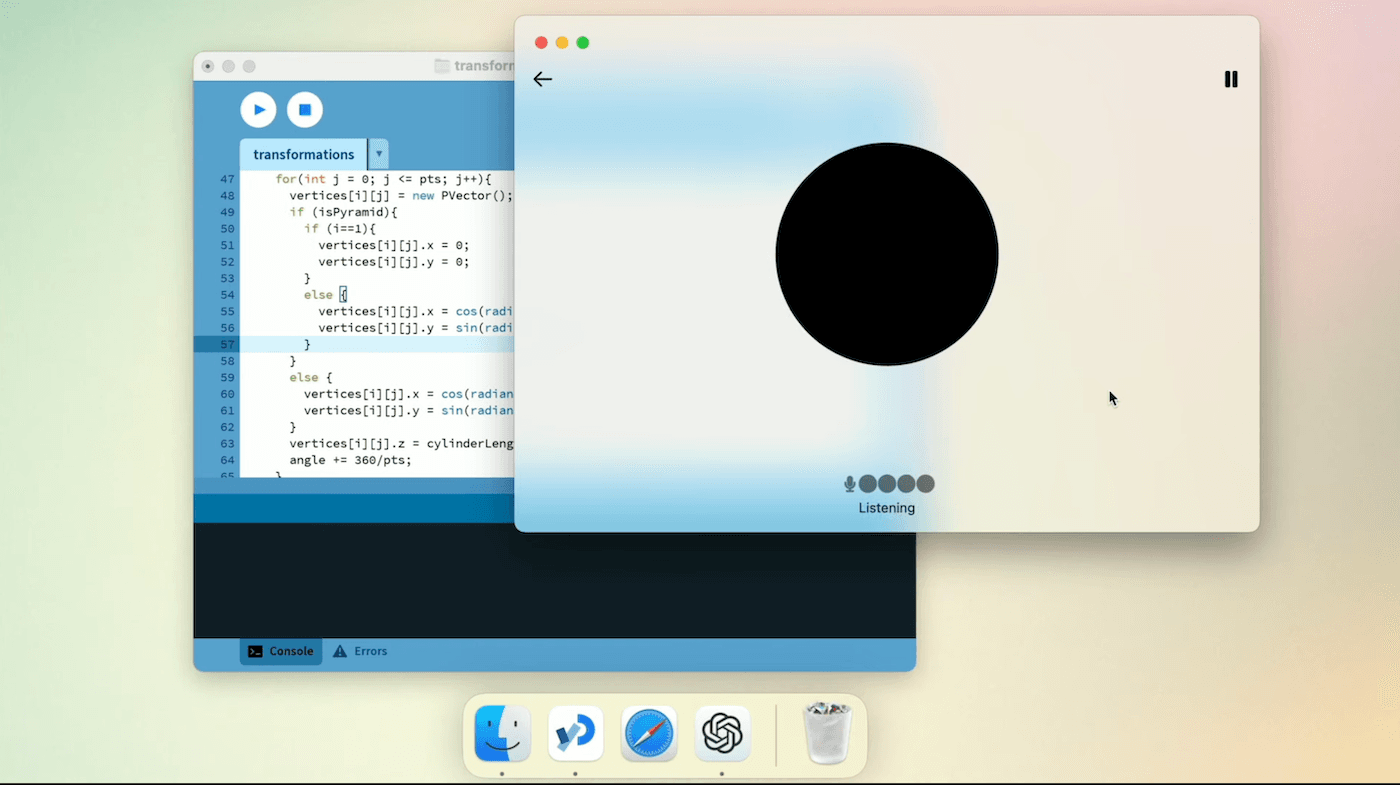
GPT-4o was trained end-to-end across text, vision and audio. OpenAI reported that it could respond to audio inputs in as little as 232 milliseconds, with an average of 320 milliseconds in its launch evaluation. This helped demonstrate how AI assistants could become more conversational and responsive, rather than requiring users to type every request.
The model also improved image understanding and multilingual text capabilities. Users could submit a photograph, ask questions about its contents, translate text in an image or discuss a visual scene. These capabilities helped establish multimodal interaction as a central part of modern AI assistants.
GPT-4o’s main capabilities at launch
| Capability | What it enabled |
|---|---|
| Text understanding and generation | Writing, summarisation, explanations, translation, question answering and coding assistance |
| Image understanding | Interpreting photographs, screenshots, charts and other visual inputs |
| Audio interaction | More natural speech-based conversations and understanding of audio inputs |
| Video understanding demonstrations | Interpreting visual information from video or a live camera feed in demonstrations |
| Multilingual support | Improved recognition and generation across a wider range of languages |
| Real-time interaction | Lower-latency responses designed to make voice conversations feel more natural |
These features describe the model’s announced capabilities and demonstrations in 2024. They should not be taken as a description of every GPT-4o API endpoint available in November 2026. The current standard GPT-4o API model page lists text and image inputs with text output; it does not list audio or video support for that standard model endpoint. Audio and real-time functions were provided through separate model variants and APIs, which have their own retirement schedules.
GPT-4o and ChatGPT: what happened to its availability?
When GPT-4o launched in May 2024, OpenAI began rolling it out to ChatGPT Plus and Team users, with availability for Enterprise users planned soon after. The company also started making it available to Free users with usage limits. At that time, the rollout included access to image understanding, data analysis, file uploads, web information and other capabilities.
That was a historical rollout, not the current ChatGPT model lineup. OpenAI retired GPT-4o from ChatGPT on 13 February 2026. Business, Enterprise and Edu workspaces retained limited access through Custom GPTs until 3 April 2026, after which GPT-4o was fully retired across ChatGPT plans. Existing conversations and GPTs were moved to newer supported model equivalents.
Therefore, users should not expect to find GPT-4o in the ChatGPT model picker in November 2026. ChatGPT’s voice experience is separate from the retired GPT-4o text model and continues to evolve with its own voice models. Retiring GPT-4o does not mean that ChatGPT has lost all voice, image or file features.
Can developers still use GPT-4o through the API?
API availability is separate from ChatGPT availability. OpenAI’s API documentation currently lists GPT-4o as deprecated rather than active. The following lifecycle details were listed on OpenAI’s deprecation page when this article was updated:
| API model or snapshot | Status as of 20 November 2026 |
|---|---|
gpt-4o-2024-05-13 |
Shut down on 23 October 2026 |
gpt-4o-2024-08-06 |
Deprecated; scheduled to shut down on 14 January 2027 |
gpt-4o-2024-11-20 |
Deprecated; scheduled to shut down on 14 January 2027 |
gpt-4o alias |
Listed as deprecated; check the API deprecation page for its current mapped version and shutdown date |
OpenAI lists gpt-6-luna as the recommended replacement for the GPT-4o versions with the January 2027 shutdown date. Developers should still test the replacement against their own prompts, output formats, quality requirements, latency targets and budgets before switching production traffic. A newer model is not guaranteed to reproduce every detail of an older model’s behaviour.
For developers who still have GPT-4o in an application, the safest approach is to identify the exact model ID in code, review API usage logs, create a migration branch, run representative evaluations and deploy the replacement gradually. Do not wait until the shutdown date to begin testing.
Current GPT-4o API capabilities and limits
There is an important difference between the original GPT-4o multimodal announcement and the current standard GPT-4o API model documentation. The API model page lists the following details for GPT-4o:
- Input: Text and images.
- Output: Text, including Structured Outputs.
- Context window: 128,000 tokens.
- Maximum output: 16,384 tokens.
- Audio and video: Not supported by the standard model endpoint described on that page.
- Lifecycle: Deprecated, with model-specific shutdown dates published by OpenAI.
GPT-4o’s audio and real-time experiences used separate endpoints or model variants. Those variants also have their own retirement notices. For example, the API deprecation schedule lists GPT-4o audio and real-time variants for shutdown on 20 January 2027, with newer audio and real-time models as recommended replacements. Developers building voice applications should therefore migrate the exact audio or real-time model IDs they use, rather than assuming that changing only gpt-4o will update their entire audio stack.
What replaced GPT-4o in ChatGPT?
ChatGPT no longer relies on GPT-4o as its general-purpose model. The product has moved to newer model families, and the model available to a user can depend on the plan, product surface, usage limits and rollout status. OpenAI’s November 2026 model notes describe GPT-6.2 models for API workloads, while ChatGPT has its own model picker and release schedule.
For Free users, OpenAI’s current Free Tier FAQ lists GPT-5.6 Luna as the available default model and includes web search, file and image uploads, data analysis, image generation and access to existing GPTs, subject to separate usage limits. Paid plans may have higher limits and additional model choices. Users should check the model picker and current plan details rather than relying on 2024 GPT-4o access information.
For developers, OpenAI announced GPT-6.2 Astra and GPT-6.2 Sol for the API on 17 November 2026. Astra is positioned for complex reasoning, coding and professional work, while Sol balances speed, cost and multi-step task capability. These models accept text and images and return text through the Responses or Chat Completions API. The right replacement depends on the application’s workload and should be validated through testing.
GPT-4o safety and responsible AI development
OpenAI published a GPT-4o System Card in August 2024 describing model evaluations, safety testing and risk mitigations. The release included work on harmful content, privacy, cybersecurity, persuasion and other areas. OpenAI said it used external red-team testing and post-training safeguards as part of the model’s development.
Safety testing does not mean a model is error-free. GPT-4o could still produce inaccurate information, misunderstand images or audio, or respond inappropriately to ambiguous prompts. Users should verify important factual claims and avoid treating AI-generated answers as professional advice in areas such as medicine, law, finance or safety-critical engineering.
For businesses, responsible deployment also means limiting access to sensitive data, applying appropriate retention and access controls, testing model outputs, documenting decisions and keeping a human accountable for high-impact actions.
How to choose a current OpenAI model for a project
If you are starting a new application, do not select GPT-4o simply because it was once OpenAI’s flagship model. Begin with the job the model must perform, then compare active models in the official catalogue.
- Text, document and image analysis: Evaluate a current general-purpose model against your real examples and structured-output requirements.
- Complex reasoning and coding: Compare a higher-capability reasoning model using a representative test set and a measurable success criterion.
- Voice and speech: Use the current audio or real-time model family rather than a deprecated GPT-4o audio endpoint.
- Image generation: Select a dedicated image-generation model. GPT-4o’s text-and-image input capability is not the same as a dedicated image-generation endpoint.
- Production reliability: Check lifecycle status, rate limits, latency, cost, regional availability, data controls and the model’s documented endpoint support before deployment.
OpenAI’s API model catalogue and deprecation schedule are the authoritative places to check whether a model is active, deprecated or shut down. The lifecycle can change, so developers should monitor those pages and set a reminder well ahead of any announced retirement date.
Frequently asked questions
What does the “o” mean in GPT-4o?
The “o” stands for “omni”, referring to the model’s design for working across multiple modalities such as text, images and audio.
When did OpenAI launch GPT-4o?
OpenAI announced GPT-4o on 13 May 2024 as a faster multimodal model with improvements across text, vision and audio.
Is GPT-4o still available in ChatGPT?
No. OpenAI retired GPT-4o from ChatGPT on 13 February 2026. It was fully retired across plans after the temporary Custom GPT transition period ended on 3 April 2026.
Can developers still use GPT-4o in the OpenAI API?
Some GPT-4o API versions remained available in deprecated status as of 20 November 2026. The listed 2024-08-06 and 2024-11-20 snapshots are scheduled to shut down on 14 January 2027. The 2024-05-13 snapshot shut down on 23 October 2026.
What is the recommended replacement for GPT-4o in the API?
OpenAI’s current deprecation page lists GPT-6 Luna as the recommended replacement for the standard GPT-4o snapshots scheduled to shut down in January 2027. Test the newer model with your application’s actual workload before migrating.
Does the current standard GPT-4o API endpoint support audio and video?
The current GPT-4o model page lists text and image input with text output, and says audio and video are not supported on that standard endpoint. Separate audio and real-time model variants have separate capabilities and retirement schedules.
Can Free ChatGPT users still upload images and analyse files?
Yes. OpenAI’s current Free Tier FAQ lists image and file uploads, data analysis, web search and image generation among Free features. These tools have usage limits that are separate from the main chat limit.
Official sources and further reading
- OpenAI: Hello GPT-4o, original launch and multimodal capabilities
- OpenAI: GPT-4o launch and 2024 Free-tier rollout
- OpenAI: GPT-4o System Card, August 2024
- OpenAI Help Centre: GPT-4o retirement from ChatGPT
- OpenAI API: GPT-4o model card and current endpoint capabilities
- OpenAI API: Model deprecation and shutdown schedule
- OpenAI Help Centre: Current ChatGPT Free-tier features and limits
- OpenAI Help Centre: ChatGPT release notes
- OpenAI Help Centre: ChatGPT desktop app for macOS and Windows
- OpenAI API: Current model catalogue
GPT-4o was an important milestone in multimodal AI, but it is no longer the current ChatGPT flagship. Readers should distinguish its 2024 launch capabilities from today’s ChatGPT features and the remaining, time-limited API availability. Check OpenAI’s official model and deprecation pages before starting a new integration or updating a production application.