Appotronics brought its ALPD laser projection technology to CinemaCon 2024 in Las Vegas, demonstrating a laser-light-source approach designed to improve cinema image quality while reducing the maintenance associated with traditional xenon lamps. ALPD stands for Advanced Laser Phosphor Display. It combines laser light with laser-excited phosphor materials to create a bright projection light source.
The technology is not a new product announced for the first time at CinemaCon. Appotronics developed ALPD in 2007 and has evolved it through several generations. The 2024 event was a showcase of its cinema light-source solutions, home-theatre systems and separate VLED LED cinema-screen technology. This guide explains how ALPD works, what the company claimed at the event, where it is being used and what cinema operators should evaluate before upgrading.
What Appotronics demonstrated at CinemaCon 2024
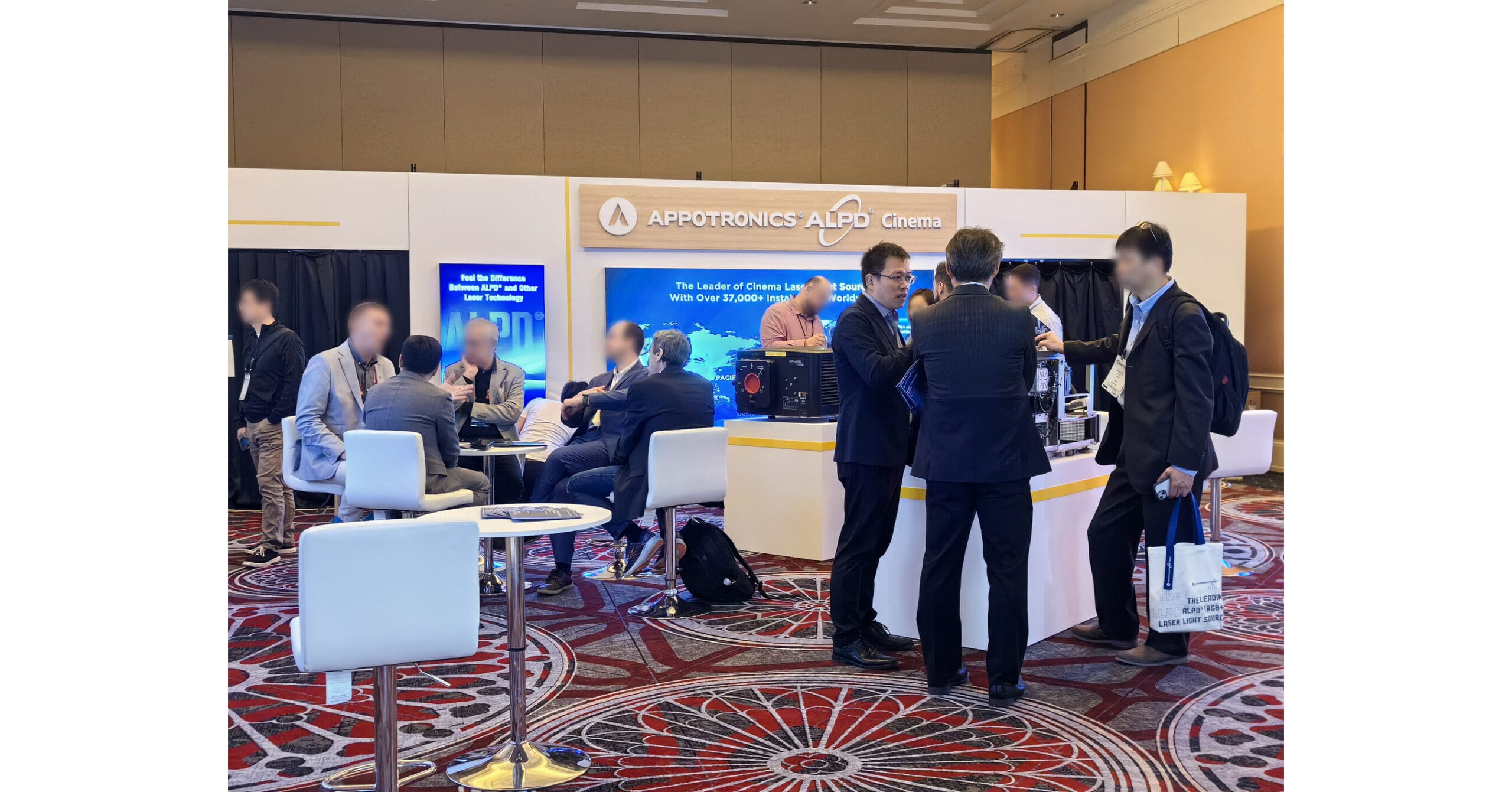
CinemaCon 2024 took place at Caesars Palace in Las Vegas from 9 to 11 April. Appotronics demonstrated an ALPD-equipped projection room and presented its laser light-source solutions to cinema exhibitors and other film-industry professionals.
The company’s announcement highlighted three areas: stable image quality with reduced visible laser speckle, a retrofit option intended to reduce the need for separate speckle-removal equipment, and lower maintenance compared with frequent xenon-lamp replacement. Appotronics also showed ALPD-based home-theatre systems and VLED LED movie screens that it said had been deployed in eight Chinese provinces.
These are different display approaches. ALPD is a laser-phosphor light-source technology used in projection systems, while a direct-view LED cinema screen creates the image on an array of LED modules rather than projecting it onto a screen. The two should not be treated as the same technology.
What is ALPD laser projection technology?
ALPD is short for Advanced Laser Phosphor Display. Appotronics describes it as a semiconductor laser light source that combines laser-excited phosphor with mixed-colour lasers. The approach is intended to combine the high brightness and efficiency of laser illumination with the colour-generation characteristics of phosphor materials.
In a simplified explanation, blue laser light excites phosphor material, which emits light at other wavelengths. The system combines these outputs with laser light to create the colour components required by the projector’s optical engine. The exact arrangement varies by ALPD generation and product design.
One reason this architecture matters is laser speckle. Laser light can produce a granular interference pattern on a projected image, particularly on uniform areas. Appotronics says its ALPD architecture reduces this effect without requiring the additional speckle-removal devices used by some other laser systems. The actual result depends on the projector, screen, installation and viewing conditions.
ALPD technology generations
Appotronics has developed multiple ALPD generations, with changes to the light-source architecture and colour performance. Its published technology overview describes the development as follows:
- ALPD 1.0: Introduced in 2007 as the company’s original laser-phosphor display approach.
- ALPD 2.0: Developed in 2012, with an emphasis on brightness, visual-safety design and light uniformity.
- ALPD 3.0: Developed in 2015 for cinema applications, using a red-and-blue laser plus phosphor approach and targeting DCI-P3 colour performance.
- ALPD 4.0: Developed in 2018, with improvements to colour gamut, contrast and light efficiency compared with the preceding generation.
- ALPD 5.0: Announced in November 2022, with more flexible optical-engine configurations and further claimed improvements in colour gamut and luminous efficiency.
These generation descriptions and performance comparisons come from Appotronics. They are useful for understanding the company’s product development, but they are not a substitute for independent measurements of a specific cinema projector and screen combination.
Why cinemas consider laser light-source upgrades
Many digital cinema projectors have traditionally used xenon lamps. Lamp-based systems require periodic lamp replacement and can involve recurring maintenance, inventory and service costs. A laser light source can reduce the frequency of light-source replacement and can maintain useful brightness over a longer operating period.
Appotronics says an ALPD laser light-source retrofit can be installed in approximately three to four hours, with the aim of limiting disruption to a cinema’s daily schedule. The actual upgrade time depends on the projector model, the condition of the equipment, the installation site and the work required for calibration.
The company’s CinemaCon 2024 release cited a 30,000-hour lifespan for its ALPD laser light source. This is a manufacturer-reported figure, not a guarantee that every projector component will operate without servicing for that period. Fans, filters, optical components, electronics and other parts can still require inspection or maintenance. Light output also changes over time.
How widely is ALPD used in cinemas?
In its CinemaCon 2024 announcement, Appotronics said that more than 37,000 cinema halls worldwide had installed its ALPD laser light-source solutions as of 31 December 2023. The company also attributed at least 568 million kWh of electricity savings and more than 249 million cubic metres of reduced CO2 emissions to those installations. These are company-reported cumulative estimates, not independently audited measurements presented in the announcement.
Appotronics’ current CINEAPPO cinema page now states that more than 43,000 cinema theatres worldwide have been equipped with its ALPD semiconductor laser light-source solutions. The company does not provide a clear measurement date alongside that figure on the page, so it should be read as a current company claim rather than a directly comparable annual growth statistic.
For cinema owners assessing these numbers, the key questions are how many installations are comparable to their own projector fleet, what electricity baseline is used, how much light output is required, and whether the savings include installation and maintenance costs over the full equipment life.
ALPD 5.0, brightness and colour performance
Appotronics’ published ALPD overview says its ALPD 5.0 platform can support a wide colour gamut, compact optical-engine configurations and higher luminous efficiency. It lists claimed colour-gamut figures of up to 120% of Rec. 2020 for the technology. The company’s broader ALPD page also lists projector brightness reaching up to 60,000 lumens for certain solutions.
These are technology or product-family claims, not a specification that applies to every ALPD projector. Cinema image quality depends on the projector model, brightness setting, screen gain and size, contrast, calibration, content mastering and the theatre’s ambient-light conditions. Operators should request the exact model’s independently measured brightness, colour coverage, contrast and warranty information.
ALPD laser projection compared with xenon lamps
Laser projection can offer longer light-source operating life, more stable brightness over time and lower routine light-source replacement requirements compared with traditional xenon lamps. It can also reduce electricity consumption in suitable installations, although the size of any saving depends on projector design, brightness target, operating hours and the previous equipment.
A retrofit may allow a cinema to retain an existing projector platform while replacing or upgrading the light source. That can be financially attractive where the projector is otherwise in good condition. However, a cinema should compare the retrofit price with a full projector replacement and account for service support, parts availability, warranty, image performance and the remaining useful life of the underlying projector.
Appotronics’ expansion beyond CinemaCon 2024
Appotronics continues to promote ALPD across cinema, professional projection and home-theatre markets. In July 2026, the company announced a partnership with Strong Technical Services to make its ALPD-powered professional projection products available to more customers in North America. The announced applications include cinemas, museums, universities, performing-arts venues and other professional audiovisual environments.
This 2026 partnership is broader than cinema projection alone. It indicates Appotronics is continuing to expand its professional projection distribution and service network, but it should not be interpreted as confirmation that a particular cinema chain has adopted ALPD.
What cinema operators should check before upgrading
- Projector compatibility: Confirm that the laser retrofit is approved for the existing projector model and its operating configuration.
- Measured image performance: Request brightness, uniformity, colour gamut, contrast and speckle measurements for the proposed installation.
- Total cost of ownership: Compare purchase and installation costs with expected electricity, lamp, maintenance and service expenses over the full operating period.
- Service and warranty: Check local technician availability, spare parts, warranty coverage and the process for repairing the laser module.
- Operating schedule: Confirm the installation and calibration window, including any theatre downtime that may be required.
- Environmental claims: Ask for the energy baseline and calculation method behind any projected electricity or emissions savings.
Frequently Asked Questions
What does ALPD stand for?
ALPD stands for Advanced Laser Phosphor Display. It is Appotronics’ laser-phosphor light-source technology for projection and display applications.
How does ALPD work?
It uses laser light to excite phosphor materials and combines the resulting light with laser components to create the light needed for image projection. The specific optical design varies across ALPD generations.
Does ALPD eliminate laser speckle?
Appotronics says its architecture provides speckle-free or reduced-speckle image performance without extra speckle-removal devices. The visible result should be assessed on the actual projector and screen installation.
How long does an ALPD laser light source last?
Appotronics cited a 30,000-hour lifespan in its CinemaCon 2024 announcement. This is a manufacturer-reported light-source figure and does not mean the entire projector requires no maintenance for 30,000 hours.
How many cinemas use ALPD?
Appotronics reported more than 37,000 equipped cinema halls as of 31 December 2023. Its current CINEAPPO page states that more than 43,000 cinema theatres worldwide have been equipped. Both figures are company-reported.
Is ALPD the same as a direct-view LED cinema screen?
No. ALPD is a laser light-source technology used in projection systems. A direct-view LED screen creates the image using LED modules. Appotronics showcased both types of display solutions at CinemaCon 2024.
Can ALPD be installed in an existing cinema projector?
Appotronics and its cinema business describe ALPD light-source upgrades for compatible projector platforms. Compatibility, installation time and performance depend on the exact projector model and retrofit package.
Official sources and further reading
- Appotronics: CinemaCon 2024 ALPD technology showcase and company-reported figures
- Appotronics: ALPD technology, generations and claimed performance
- CINEAPPO: Cinema laser upgrades and current deployment statement
- Appotronics: Strong Technical Services partnership, July 2026
- CinemaCon: Official event website
Appotronics’ CinemaCon showcase reflected a wider shift in cinema projection toward laser illumination, longer light-source life and lower routine lamp-replacement requirements. ALPD offers a practical upgrade path for compatible theatres, but operators should base investment decisions on model-specific performance, service support and independently checked operating costs rather than headline claims alone.