SolarDuck’s Merganser project reached an important milestone in offshore renewable energy when Bureau Veritas awarded it a prototype certification in March 2024. The 0.5 MWp pilot was developed to test whether floating solar panels can operate safely in the demanding conditions of the North Sea. The certification was described by Bureau Veritas as the world’s first prototype certification for a floating offshore solar solution.
The milestone was not a declaration that offshore floating solar was already commercially proven at large scale. It was a technical assessment of a specific prototype design, including its floating structure, mooring arrangement, stability, materials and electrical safety. The project subsequently moved from certification toward real-world testing.
What is SolarDuck’s Merganser project?
Merganser is a floating offshore photovoltaic pilot developed by Dutch-Norwegian company SolarDuck with support from RWE. The system has a planned capacity of approximately 0.5 MWp, also reported as 520 kWp, and is built from six interconnected floating platforms carrying solar panels.
Unlike conventional floating solar installations on sheltered lakes or reservoirs, Merganser is designed for offshore conditions. Its modular platforms are elevated above the water and connected so that the structure can respond to waves while keeping key electrical components away from direct contact with seawater.
Why did Bureau Veritas certify the prototype?
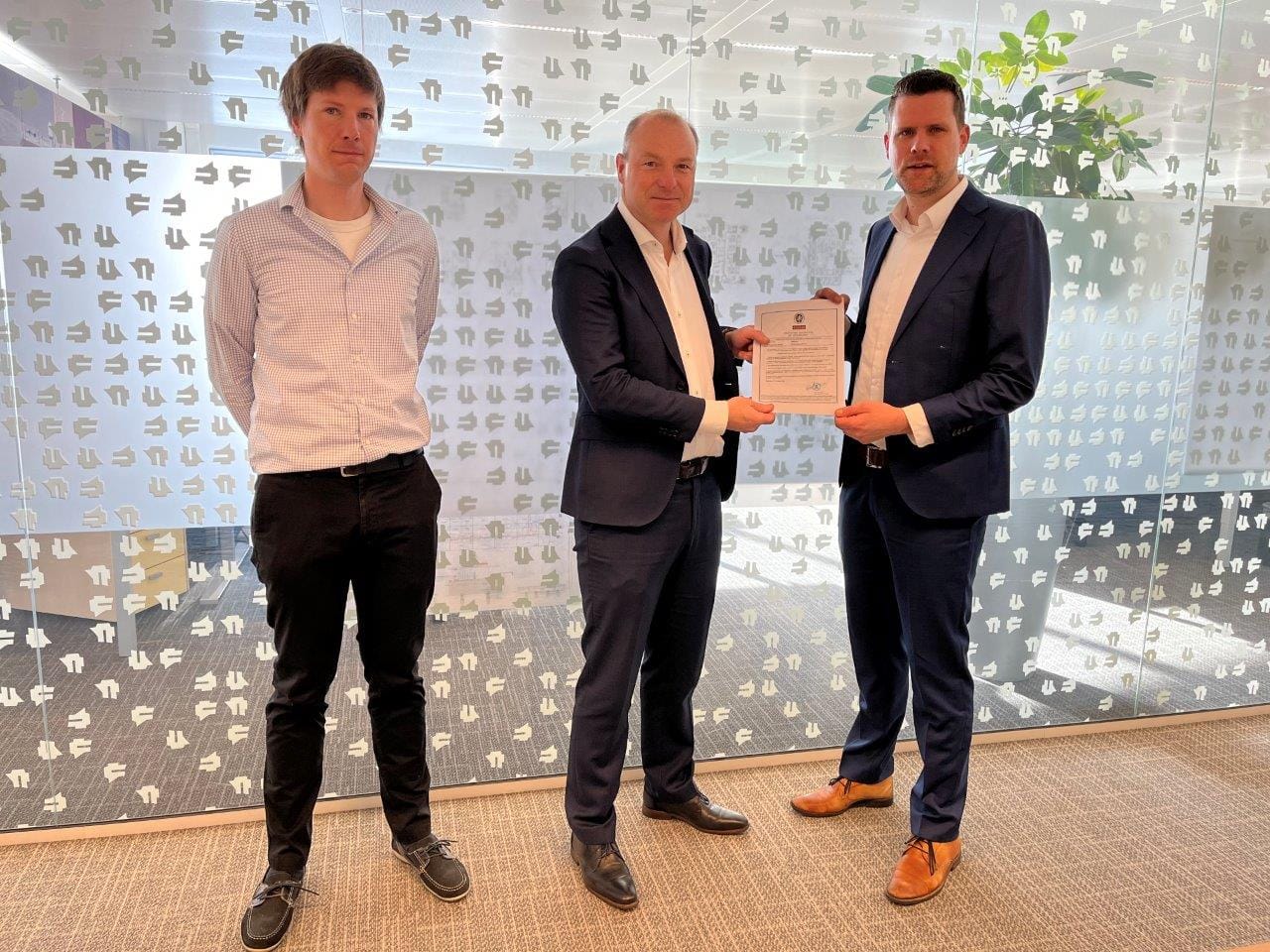
On 27 March 2024, Bureau Veritas announced that it had awarded prototype certification to SolarDuck’s Merganser technology. The assessment followed an earlier Approval in Principle for the floating structure and used relevant marine renewable-energy rules and standards, including Bureau Veritas guidance note NI631.
The review covered several engineering areas:
- Structural design and integrity of the floating platforms.
- Mooring system and the ability to keep the array in position.
- Stability under demanding offshore conditions.
- Materials intended for a marine environment.
- Electrical safety considerations for the solar installation.
The design assessment included a maximum wave height of 11.6 metres at a water depth of 21.5 metres for the North Sea Farmers test-site conditions. These are design conditions reported for the project, not a claim that the pilot has already operated through every possible storm or sea state.
How is the floating solar platform designed?
SolarDuck uses a modular, triangular-platform concept. The interconnected units are designed to sit several metres above the water and move with the waves as a connected array. Raising the panels and electrical components helps reduce exposure to splashing water and supports access for inspection and maintenance.
Offshore environments create challenges that are less severe on inland reservoirs. Waves, wind loading, saltwater corrosion, fatigue, mooring loads and difficult maintenance access all need to be considered. A successful design must balance structural strength, electrical safety, serviceability and cost.
From certification to offshore installation
Certification was an early step in the project timeline. On 4 July 2024, RWE announced that SolarDuck and its partners had successfully installed the 0.5 MWp Merganser pilot at the North Sea Farmers offshore test site in the Dutch North Sea, approximately 12 kilometres off Scheveningen.
The installation consists of six interconnected platforms connected to a mooring system in water around 20 metres deep. RWE said the next phase would include technical and environmental monitoring. The project was intended to gather practical knowledge about structural performance, mooring and electrical systems, manufacturing, assembly, offshore installation and maintenance.
RWE also reported that the array carried more than 180 sensors to monitor factors such as structural loads, connector and mooring loads, and electrical performance. Environmental monitoring was planned with support from Deltares. These measurements are important because a prototype must demonstrate more than the ability to float: it must also show dependable operation and acceptable environmental performance over time.
Why offshore floating solar matters
Offshore solar could create additional renewable-energy capacity in regions where suitable land is limited. It may also complement offshore wind farms by sharing parts of the offshore energy ecosystem, such as marine infrastructure, operations knowledge and grid connections. SolarDuck and RWE have explored the possibility of combining floating solar with offshore wind developments.
However, offshore solar is not automatically cheaper or more productive than land-based solar. Marine structures, cables, moorings, installation vessels, corrosion protection and maintenance can add significant costs. Developers must prove that the additional energy generation and shared infrastructure justify those costs.
What certification does and does not prove
Prototype certification provides independent technical scrutiny of a defined design and can help project developers, partners and investors understand whether key safety and engineering requirements have been addressed. It is an important step toward demonstrating that a technology is suitable for further testing.
It should not be confused with full type certification, a commercial operating permit, a guarantee of long-term reliability, or proof that a large offshore solar farm is economically viable. Bureau Veritas said the technology would be further evaluated for type certification. Real-world monitoring and additional engineering validation remain important parts of the development process.
Frequently Asked Questions
What is SolarDuck Merganser?
Merganser is a 0.5 MWp floating offshore solar pilot made from six interconnected platforms and developed by SolarDuck with support from RWE.
Who certified SolarDuck’s Merganser prototype?
Bureau Veritas awarded the prototype certification on 27 March 2024 after assessing the floating structure, mooring, stability, materials and electrical safety aspects.
How large are the waves the design was assessed for?
The reported design assessment included a maximum wave height of 11.6 metres at a water depth of 21.5 metres for the specified North Sea test-site conditions.
Where was Merganser installed?
RWE announced its installation in July 2024 at the North Sea Farmers offshore test site in the Dutch North Sea, approximately 12 kilometres off Scheveningen.
Does prototype certification mean the technology is commercially ready?
No. Prototype certification is a significant engineering milestone, but further type certification, monitoring, operational evidence and commercial assessment are needed before large-scale deployment can be considered proven.
Research and Further Reading
- Bureau Veritas: Merganser prototype certification announcement
- RWE: Merganser offshore installation, July 2024
- pv magazine: Bureau Veritas certifies SolarDuck’s offshore platform
- Nautical SUNRISE: Offshore floating solar research project
In summary: SolarDuck’s Merganser certification and subsequent offshore installation represent meaningful progress for floating solar in rough marine environments. The next test is sustained performance: reliable energy production, safe mooring, manageable maintenance and responsible environmental impact over time.