
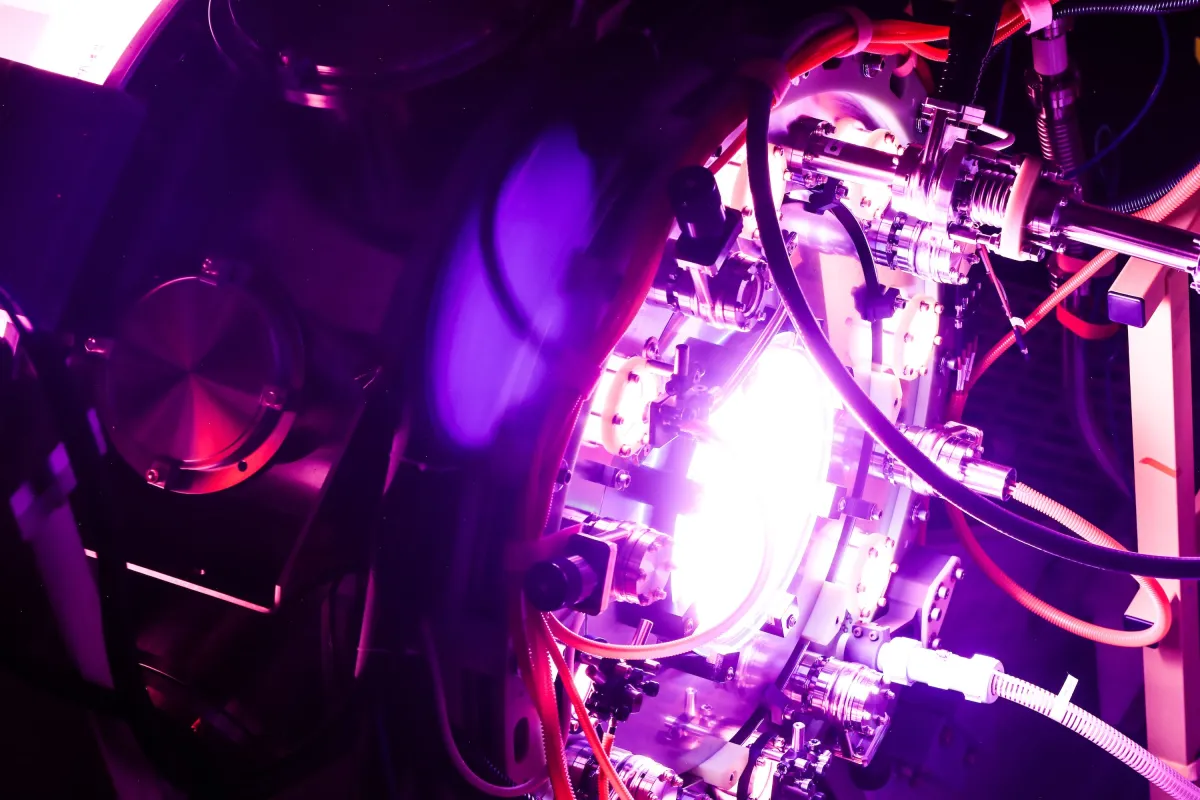
Helion Achieves Breakthrough in Fusion Energy with Milestone Plasma Temperature
In an exciting development for the future of fusion energy, Helion, a startup based in Everett, Washington, has announced that its Polaris prototype reactor has reached a staggering plasma temperature of 150 million degrees Celsius. This achievement brings the company closer to meeting its goal for commercial fusion power, signaling a significant step forward in the quest for a sustainable energy solution.
“We’re obviously really excited to be able to get to this place,” stated David Kirtley, Helion’s co-founder and CEO, in an interview with TechCrunch. This milestone marks a vital point in the race towards harnessing fusion energy, which promises an almost limitless and clean energy source.
Key Highlights from Helion’s Recent Progress
Helion’s Polaris reactor operates on a unique fuel combination of deuterium and tritium, making it the first fusion venture to utilize this fuel type. Kirtley noted that the company observed a significant increase in fusion power output, particularly in the form of heat, as they progressed in their experiments.
The push for commercializing fusion energy is heating up, with Helion among several startups competing in this space. The potential of fusion to provide clean energy has caught the attention of investors, as seen with Inertia Enterprises’ recent $450 million Series A funding round involving notable firms like Bessemer and GV. Last year, Helion itself raised $425 million from a consortium that included Sam Altman, Mithril, Lightspeed, and SoftBank.
Contracts and Future Aspirations
While most fusion startups are targeting the early 2030s to begin supplying electricity to the grid, Helion stands out with its contract to provide electricity to Microsoft starting in 2028. This electricity will come from another reactor, Orion, which is currently under construction, rather than from Polaris.
It’s important to note that each fusion startup has unique milestones tailored to their reactor designs. For instance, Commonwealth Fusion Systems aims to heat its plasmas to over 100 million degrees Celsius using a tokamak—a doughnut-shaped device employing powerful magnets to contain plasma. However, Helion’s reactor, designed as a field-reversed configuration, requires plasmas that are much hotter to function optimally.
Innovative Reactor Design and Energy Generation
The internal structure of Helion’s reactor resembles an hourglass. Fuel is injected at the wider ends and transformed into plasma, which is then accelerated toward the center. Upon merging, the plasma quickly reaches temperatures of 10 to 20 million degrees Celsius, further compressed by powerful magnets to achieve the recent milestone of 150 million degrees Celsius in less than a millisecond. This rapid process is pivotal for efficient energy generation.
Unlike traditional methods that extract energy from fusion reactions as heat, Helion employs the plasma’s own magnetic field to generate electricity. By capturing electricity directly from the fusion reactions, Helion aims to improve efficiency compared to its competitors. Over the past year, Kirtley revealed that the company has enhanced the reactor’s circuits to optimize electrical recovery.
Future Fuel and Sustainability
At present, Helion utilizes deuterium and tritium for fueling its reactor but has plans to transition to deuterium-helium-3 in the future. This fuel combination produces charged particles that exert force against the magnetic fields confining plasma, making it more suitable for Helion’s innovative approach. “We believe that at 200 million degrees, that’s where you get into that optimal sweet spot for operating a power plant,” Kirtley stated, outlining the company’s ambitious targets.
One challenge Helion faces is that helium-3 is relatively scarce on Earth. To address this, the company will initially use deuterium nuclei for fusion and later produce helium-3 through deuterium-on-deuterium reactions. Work is already in progress to refine this fuel cycle, with Kirtley expressing optimism about achieving high efficiency in producing helium-3.
Looking Ahead: A New Era of Fusion Energy
As Helion continues to make advancements with Polaris and the construction of its larger Orion reactor, the company’s ambition is not merely to deliver Polaris, but to pave the way for scaled power plants that can impact the global energy landscape.
For more information on Helion and the future of fusion energy, check out [our blog](https://www.axomlive.in/blog), which explores the latest technological innovations.