
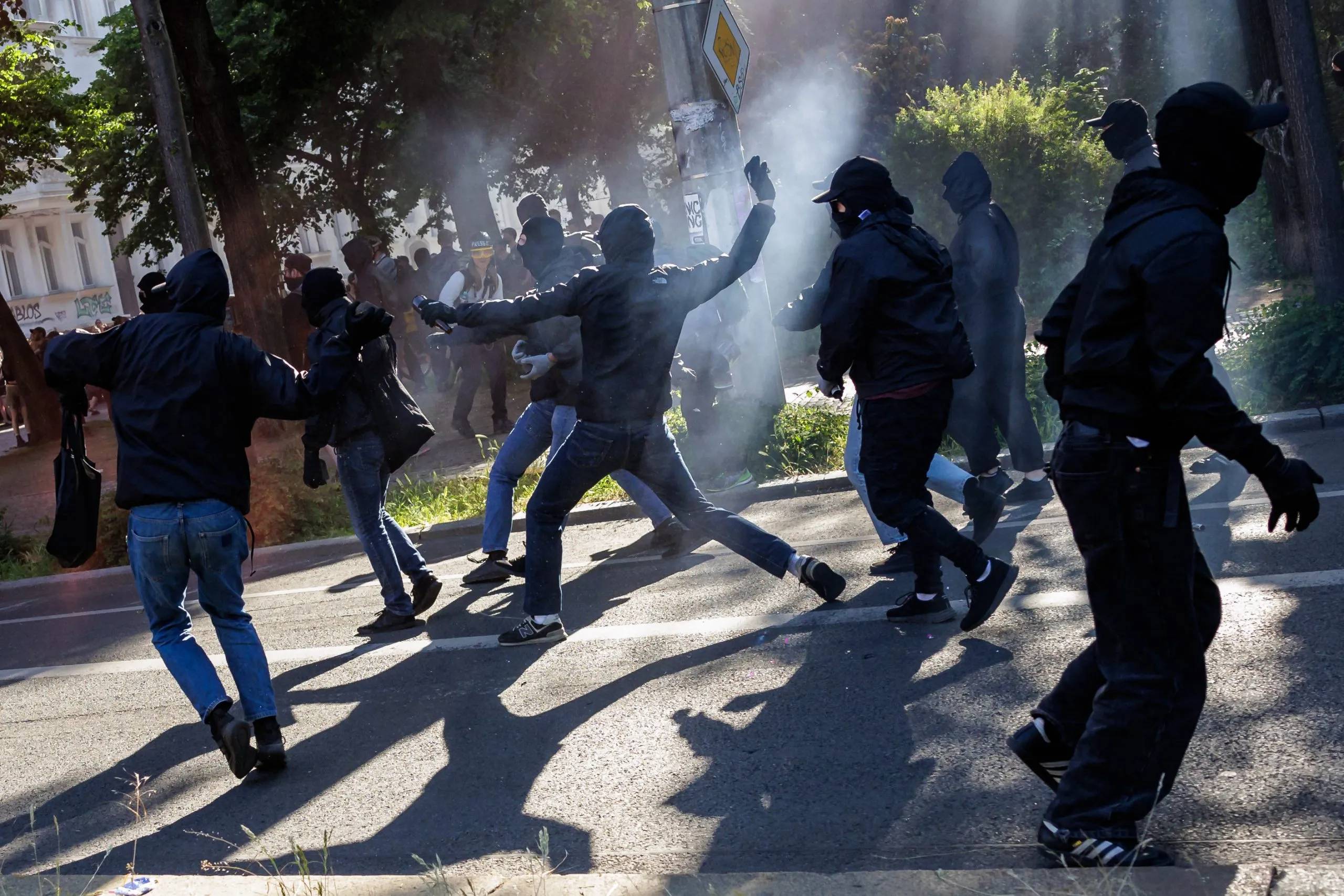
A high-profile trial begins for seven suspected members of the German far-left militant group Antifa Ost, who are accused of carrying out violent attacks against right-wing extremists, earning them the moniker “Hammer Gang.” This trial, which marks a significant moment in Germany’s long-standing conflict between far-left and far-right factions, is set to unfold in the eastern city of Dresden, with proceedings anticipated to last until July 2026.
The U.S. government has recently classified Antifa Ost as a terrorist organization, alongside several other extremist groups in Europe. This designation not only highlights the growing concern over leftist violence but also impacts the group’s members by restricting their entry into the U.S. and freezing any financial assets they may possess.
According to prosecutors, the group is responsible for a series of attacks across Germany and Hungary from 2018 to 2023. Among these incidents was an assault on a restaurant in Thuringia, which allegedly served as a hub for right-wing activists. The owner of this establishment reportedly faced assaults on multiple occasions. Disturbingly, some suspects have been accused of wounding presumed right-wing extremists with hammers, leading to severe injuries.
The trial involves six men and one woman, including two key suspects: Johann G and Paul M. Both are also implicated in violent incidents in Hungary, specifically during a February 2023 event known as the “Day of Honour,” which attracts right-wing extremists from various parts of Europe. Their involvement further underscores the transnational nature of extremist activities.
Another German activist, Maja T, is facing trial in Hungary for her alleged attempts to assault neo-Nazi individuals leading up to the same rally. This situation exemplifies the rising tide of political violence swept across Europe, particularly in regions like eastern Germany, long known for harboring both right-wing and antifascist groups.
Prosecutors have characterized Johann G as a prominent figure within Antifa Ost, tasked with orchestrating attacks and enlisting new members. Alongside Paul M, he reportedly arranged training sessions where leftist militants practiced combat techniques, preparing for violent confrontations. Additionally, stockpiles of hammers, pepper spray, disguises, and mobile devices were supposedly discovered in locations overseen by Paul M.
The issue of political extremism in Germany is complex and multi-faceted. Ex-communist eastern Germany has not only been a breeding ground for far-right youth groups but has also seen a rise in militant antifascist movements that actively oppose them. This ongoing struggle highlights the societal rifts within the country.
Further complicating matters is the case of Lina E, another militant associated with Antifa Ost who gained significant attention after her conviction in 2023 for participating in attacks against alleged far-right targets. Her situation has sparked debates within leftist activist circles, reflecting the contentious nature of political engagement in modern Germany.
In the U.S., the recent classification of Antifa Ost as a terrorist group was part of a wider initiative led by former President Donald Trump to crack down on antifascist activists. The implications of this designation extend beyond the immediate legal ramifications, as it essentially categorizes all members as engaged in terrorism, drastically altering their ability to operate and travel.
Reacting to the U.S. designation, the far-right Alternative for Germany (AfD) welcomed this move, urging the German government to consider similar actions. However, the German foreign ministry has taken a more reserved approach, indicating that it has merely “taken note” of the situation, rather than expressing intention to follow suit.
An interior ministry spokesperson noted that the perceived threat from Antifa Ost has significantly diminished recently, stating that many of the group’s leaders and most violent members have either been convicted or are currently in custody.
This trial will not only serve as a focal point for discussions around political violence in Germany but will also potentially influence the broader European landscape regarding how governments respond to extremist groups. The ongoing tensions between leftist and rightist factions underscore a societal struggle that continues to pose serious challenges within Germany and beyond.
In conclusion, as the proceedings unfold, the world’s attention turns to Dresden, looking for insights into how society grapples with political extremism in all its forms. The trial of Antifa Ost provides a unique lens through which to assess the state of political discourse, security, and civil liberties in contemporary Europe. It remains crucial for policymakers and citizens alike to remain engaged on this issue, keeping in mind the broader implications on democracy and social cohesion.