
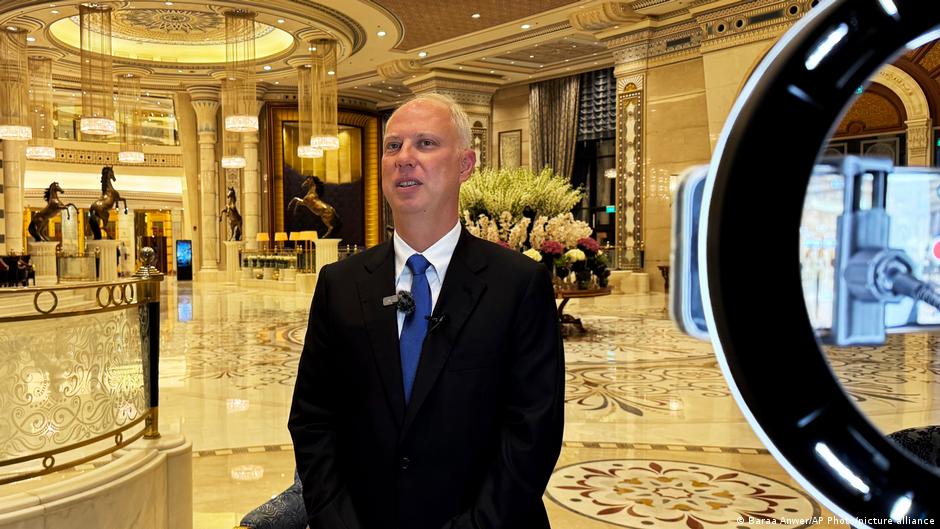
In the complex and often opaque world of Russian foreign policy, a new power player has emerged from the shadows of high finance to become one of President Vladimir Putin’s most valuable diplomatic assets. His name is Kirill Dmitriev, and his journey from a Stanford-educated investment banker to a central figure in brokering peace talks with the United States is a story of calculated networking and strategic influence.
While seasoned diplomats like Sergey Lavrov handle the official channels, Dmitriev has become the Kremlin’s go-to negotiator for the delicate, behind-the-scenes work that defines modern geopolitics, especially since the start of Donald Trump’s second term.
From Goldman Sachs to the Kremlin’s Inner Circle
Kirill Dmitriev’s background reads like a global financier’s resume. Born in Kyiv during the Soviet era—a detail he has since reframed, insisting he was born in the USSR, not Ukraine—Dmitriev pursued higher education at Stanford University in the United States. He cut his teeth at prestigious institutions like the investment bank Goldman Sachs and the consultancy McKinsey & Company.
He later built his career on both sides of the post-Soviet landscape, managing a $500 million fund at Delta Private Equity Partners in Russia and overseeing a fund belonging to the son-in-law of former Ukrainian President Leonid Kuchma. This dual experience gave him a unique understanding of the economic and political dynamics in the region.
His official entry into the Russian state apparatus came in 2011 when he was appointed head of the Russian Direct Investment Fund (RDIF), a vehicle designed to attract foreign capital. However, his real influence stems not just from his professional roles but from his formidable social capital.
The Putin Connection: A Web of Family and Friendship
Analysts point to a crucial relationship that likely propelled Dmitriev into Putin’s orbit. His wife is reportedly a close friend of Katerina Tikhonova, who is widely believed to be Vladimir Putin’s daughter. According to experts, the bond between the two families is deep and extends beyond mere friendship, creating a personal link to the Russian president that is invaluable in the Kremlin’s hierarchy.
This connection, combined with his Western education and financial acumen, made him the ideal candidate for a role that required trust, discretion, and an ability to navigate international circles that were becoming increasingly closed to traditional Russian officials.
The Unofficial Envoy: Diplomacy Through a “Weak Link”
Dmitriev’s work as a backchannel began during Donald Trump’s first term, when he engaged in discussions with Trump’s son-in-law, Jared Kushner, about potential U.S. investments in Russia. However, his role expanded dramatically after the full-scale invasion of Ukraine and the subsequent international isolation of Russia.
In a significant move, Putin appointed Dmitriev as a presidential special envoy for investment and economic cooperation in February 2025, solidifying his diplomatic status. According to former Russian diplomat Boris Bondarev, Dmitriev now serves as a key channel for the Kremlin, specifically tasked with managing contacts with U.S. special envoy Steve Witkoff. Bondarev characterized this assignment as the Kremlin strategically targeting a perceived “weak link” in the Trump administration to advance Russia’s agenda.
Political analyst Abbas Gallyamov suggests that Dmitriev represents a different school of thought from the hardline approach of Foreign Minister Sergey Lavrov. Dmitriev is seen as a figure oriented toward compromise and deal-making. This theory was seemingly underscored by Putin’s decision to include Dmitriev, and not Lavrov, in a meeting with the U.S. envoy during a recent visit to Moscow.
Dmitriev’s effectiveness was proven when he played a pivotal role in organizing a trip for Putin to Saudi Arabia and the UAE, a challenging feat after the International Criminal Court’s arrest warrant limited the Russian leader’s travel. Beyond the diplomacy, Dmitriev’s RDIF successfully attracted crucial investments from these nations, filling the void left by departing Western capital.
In the high-stakes arena of Russia-West relations, Kirill Dmitriev is no longer just a financier. He has become the embodiment of Putin’s parallel diplomacy—a trusted insider using economic leverage and personal connections to navigate a hostile world.