
Airbound Secures $37 Million to Revolutionize Drone Delivery in India
Airbound, an innovative startup from India focusing on autonomous drone technology, has successfully raised $37 million in a recent funding round. This investment aims to make aerial logistics as affordable as traditional trucking, a move that could transform goods transportation in the region.
Recent Funding and Growth Trajectory
The Series A funding round was led by Greenoaks and included contributions from notable investors such as DoorDash, Lachy Groom, Lightspeed, and Humba Ventures. This latest round of financing comes on the heels of an $8.65 million seed round raised less than a year ago, bringing Airbound’s total funding to nearly $50 million since its inception three years ago.
Competing with Conventional Transport
Airbound and its competitors believe that drones can offer a faster and cheaper alternative for transporting certain goods compared to road vehicles. While drone delivery has seen successful implementations, scaling it up to match trucking’s versatility remains a significant challenge. Founding CEO Naman Pushp is focused on bridging this gap by refining drone designs to enhance their competitiveness against traditional ground transportation.
Innovative Drone Designs
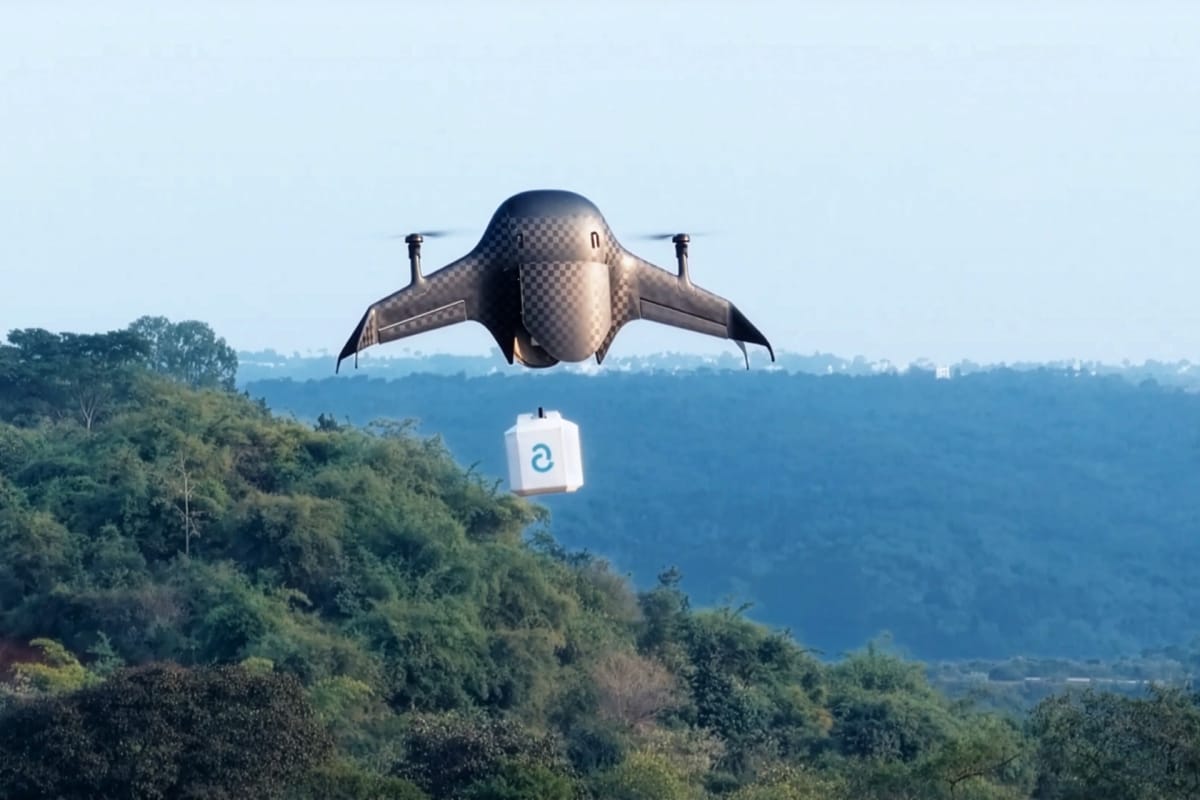
Current models like Airbound’s TRT drone weigh approximately 3.3 pounds and can carry around 2.2 pounds of cargo. The next iteration, which is under development, is expected to weigh around 6.6 pounds and transport up to 11 pounds of goods. Pushp emphasizes that the company’s unique rocket-like, tail-sitter design allows for vertical takeoff and landing, thus eliminating the need for runways as they expand their fleet.
Drone Deliveries in Healthcare
Airbound has already demonstrated its capabilities by completing over 13,000 autonomous flights in southern Indian cities like Bengaluru and Guntur. Notably, they have partnered with Narayana Health, a major hospital network, to transport diagnostic samples between facilities. This partnership highlights the advantages of drones, as they can deliver samples in just seven minutes over a distance of 2.5 miles—far quicker than the three to five hours required by conventional two-wheelers.
Expansion Plans and Ambitions
Aiming for broader expansion, Airbound has plans to establish a drone delivery network connecting three cities within Andhra Pradesh. They have signed an agreement with the local government to facilitate up to 10,000 daily flights dedicated to retail, e-commerce, and healthcare deliveries. Achieving this target will necessitate between 250 and 1,000 drones, with Pushp optimistic about starting on the lower end of this range.
Future Aspirations
Unlike other startups in the aerial logistics space, such as Skye Air Mobility and TSAW Drones, Airbound isn’t solely focused on becoming the largest delivery operator. Instead, they aspire to manufacture aircraft that other logistics networks can utilize, much like Boeing for commercial airlines, as stated by Pushp.
Manufacturing and Regulatory Challenges
The company designs and builds its aircraft in a spacious 43,000-square-foot facility in Bengaluru. While specifics on production capacity remain undisclosed, Pushp assures that manufacturing won’t be a bottleneck as they scale up. However, regulatory hurdles, particularly in securing approvals for beyond-visual-line-of-sight (BVLOS) operations, pose significant challenges that could limit commercial revenue opportunities. Despite having a dedicated team of over 150 employees, Airbound remains largely pre-revenue.
Looking Ahead
Pushp expresses a long-term vision for Airbound, aiming to establish the company as a leader in the aerial logistics sector over the next few decades, rather than seeking immediate revenue.
As Airbound takes significant steps towards revolutionizing drone delivery, its journey reflects a broader trend in India’s logistics sector, where innovation meets regulatory challenges in an increasingly competitive landscape.