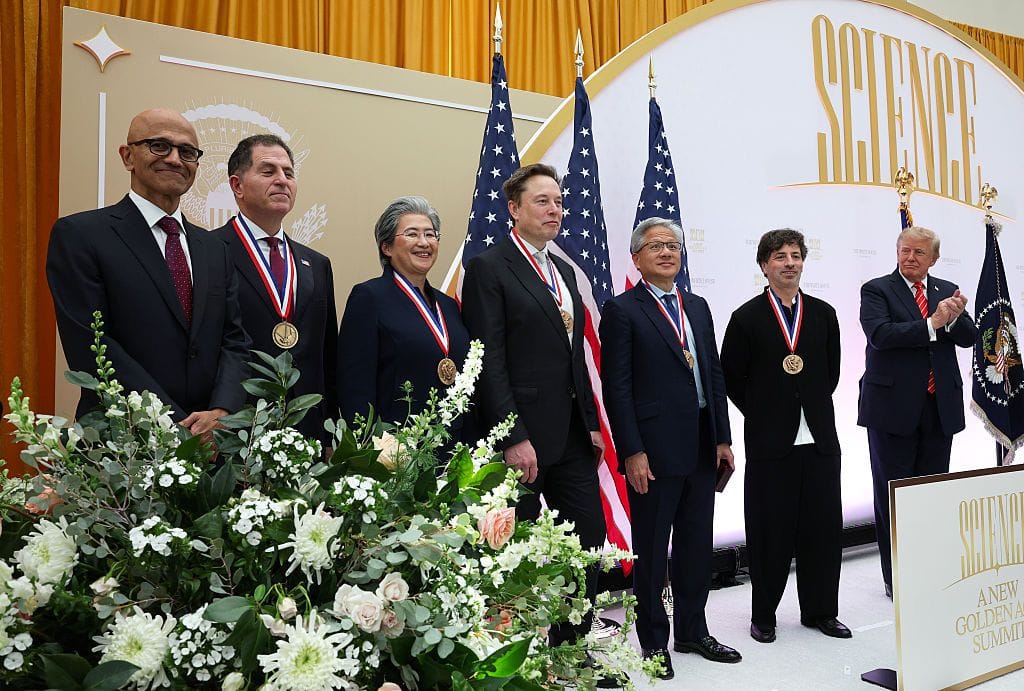
President Donald Trump presented the National Medal of Science and the National Medal of Technology and Innovation to six prominent technology leaders at the Science: A New Golden Age Summit on October 8, 2026. The recipients were Elon Musk, Sergey Brin, Jensen Huang, Lisa Su, Michael Dell and Satya Nadella.
Four received the National Medal of Science: Musk, Brin, Huang and Su. Dell and Nadella received the National Medal of Technology and Innovation. These are separate federal honours with different purposes. The first recognises outstanding contributions to science and engineering, while the second recognises technological achievement and its impact on the country.
The ceremony attracted attention not only because of the recipients’ influence in technology, but also because of their business and political connections. This article explains what each medal recognises, why the six leaders were selected, what the official citations say and how to understand the debate around private-sector influence on US science policy.
Which technology leaders received the medals?
The White House confirmed the six recipients and the medal awarded to each person in its October 8 announcement.
| Recipient | Organisation or role | Medal |
|---|---|---|
| Elon Musk | SpaceX and Tesla | National Medal of Science |
| Sergey Brin | Google co-founder | National Medal of Science |
| Jensen Huang | Nvidia CEO | National Medal of Science |
| Lisa Su | AMD CEO | National Medal of Science |
| Michael Dell | Dell Technologies founder and CEO | National Medal of Technology and Innovation |
| Satya Nadella | Microsoft CEO | National Medal of Technology and Innovation |
The White House said the awards recognised contributions across fields including computing, semiconductor design, information retrieval, space exploration, communications and the development of large-scale technology infrastructure.
What is the National Medal of Science?
The National Medal of Science is a federal honour established in 1963. It recognises individuals whose contributions have advanced knowledge in the physical, biological, mathematical, engineering or social sciences. The National Science Foundation administers the award process and supports the President’s National Medal of Science committee.
The medal is intended to recognise scientific and engineering achievement, rather than general popularity or company size. Recipients are recognised for the substance and impact of their work. The official award citation provides the administration’s stated reason for recognising each person.
In 2026, Musk, Brin, Huang and Su received this medal. Their official citations refer to achievements in space exploration and intelligent systems, information retrieval, general-purpose parallel computing, semiconductor engineering and high-performance computing.
What is the National Medal of Technology and Innovation?
The National Medal of Technology and Innovation recognises individuals and teams for outstanding contributions to the development, commercialisation and use of technology. It was first awarded in 1985 and is administered through the US Department of Commerce and the US Patent and Trademark Office.
Unlike the National Medal of Science, which focuses on contributions to scientific and engineering knowledge, the technology medal highlights technological innovation and its wider economic and social impact. The 2026 recipients were Michael Dell and Satya Nadella.
Why Elon Musk received the National Medal of Science
The White House citation recognised Musk for engineering achievements in space exploration, intelligent systems, communications and manufacturing. It highlighted the scale of SpaceX’s work and the role of his companies in pushing commercial space technology forward.
SpaceX has developed reusable launch vehicles and spacecraft, while Starlink operates a large satellite communications network. Musk is also associated with Tesla’s electric vehicle and energy businesses. The official citation describes the administration’s reasons for the award; it does not mean every policy or business decision made by Musk has been endorsed by the medal.
Why Sergey Brin received the National Medal of Science
Google co-founder Sergey Brin was recognised for foundational algorithms in information retrieval and data processing. The White House citation says this work changed how people access information across science, commerce and everyday life.
Search engines depend on systems that organise, rank and retrieve information from very large collections of data. Google’s early search technology helped make web search faster and more useful at global scale. Brin’s recognition reflects the scientific and engineering foundations behind information access, rather than a single recent product announcement.
Why Jensen Huang received the National Medal of Science
Nvidia CEO Jensen Huang was recognised for helping turn the graphics processing unit into a general-purpose computing architecture. GPUs were initially associated mainly with graphics, but parallel processing made them valuable for scientific computing, machine learning and modern AI workloads.
The White House citation highlighted processor design and software innovations that transformed massively parallel computation. Nvidia’s CUDA software ecosystem and GPU hardware have become important tools for researchers and companies building large-scale AI systems.
Why Lisa Su received the National Medal of Science
AMD CEO Lisa Su was recognised for leadership in semiconductor engineering and high-performance computing. The official citation points to innovations in processor architecture and chiplet-based integration, which allow complex processors to be built from multiple connected dies.
AMD’s EPYC server processors and Instinct accelerators are used in data centres and high-performance computing systems. The citation also highlighted AMD technology’s role in powering the world’s first exascale supercomputer. Su’s award recognises engineering leadership and the development of computing platforms, not simply the company’s stock performance.
Why Michael Dell received the National Medal of Technology and Innovation
Michael Dell was recognised for advancing the adoption of personal and enterprise computing and for building a global technology company. The White House citation highlighted his technical and business leadership and his support for future scientists, engineers and technologists.
Dell Technologies grew from a personal-computer business into a major supplier of enterprise hardware, servers, storage and infrastructure. Its products support businesses, schools, governments and data centres. The technology medal recognises the broader impact of that work on the adoption of computing.
Why Satya Nadella received the National Medal of Technology and Innovation
Microsoft CEO Satya Nadella was recognised for transforming the company during the shift toward cloud computing and for building hyperscale infrastructure used to train and deploy advanced AI systems.
Under Nadella’s leadership, Microsoft expanded Azure, its cloud platform, and invested heavily in data centres, developer tools and AI services. The White House citation specifically referred to cloud computing and the infrastructure supporting advanced AI deployment.
What happened at the October 8 summit?
The awards were presented during the Science: A New Golden Age Summit at the US Institute of Peace in Washington, DC. The event brought together technology executives, scientists and government officials to discuss US scientific leadership and research priorities.
The White House framed the ceremony as recognition of private-sector contributions to national innovation. Its wider science agenda included recommendations for research funding, support for early-career scientists, ambitious national research missions and the use of AI in scientific discovery.
The official presentation transcript records the President’s remarks and the presentation of the six medals. It is a useful primary source for checking the ceremony, recipients and the citations read at the event.
Political donations and the debate about influence
The awards also prompted questions about the relationship between major technology companies, their executives and the Trump administration. TechCrunch reported, citing The New Republic, that the awardees and their companies had contributed substantial sums to initiatives associated with Trump and his administration.
Those figures need careful interpretation. Corporate inauguration contributions, political action committee support, personal political donations and philanthropic commitments to government programmes are different kinds of financial activity. For example, the widely reported $6.25 billion commitment from Michael and Susan Dell was for Trump Accounts, a child savings initiative. It should not automatically be described as a campaign donation or a personal payment to the President.
Financial contributions can raise legitimate questions about access, influence and public confidence. However, the existence of a donation does not by itself prove that a medal was granted in exchange for money. Establishing that would require evidence beyond timing or association. The award criteria, nomination process and official records should be assessed separately from political commentary.
Why the H-1B visa timing drew attention
The ceremony also took place amid controversy over US immigration policy and technology hiring. News reports on October 8 described an administration action affecting Microsoft’s ability to use the H-1B visa programme, alongside scrutiny of other technology employers. The juxtaposition attracted attention because Nadella received a national technology honour at the same time that the company faced immigration-related uncertainty.
The H-1B programme allows eligible US employers to hire foreign workers in specialised occupations, subject to statutory requirements and government approval. It is important not to confuse a reported investigation, a proposed restriction, a temporary administrative action and a final company-wide ban. Readers should consult the relevant Department of Homeland Security and US Citizenship and Immigration Services notices for the precise legal status of any restriction.
How are the two medals different?
| Feature | National Medal of Science | National Medal of Technology and Innovation |
|---|---|---|
| Primary focus | Scientific and engineering contributions | Technological innovation and impact |
| Established | 1963 | 1985 |
| Administration | National Science Foundation | US Department of Commerce and USPTO |
| 2026 recipients | Musk, Brin, Huang and Su | Dell and Nadella |
Both are among the highest US honours in their respective fields, but they are not interchangeable. A scientist may be recognised for advancing fundamental knowledge, while a technology leader may be recognised for turning engineering and innovation into widely adopted products and infrastructure.
What the awards mean for the technology industry
The 2026 recipients represent areas that increasingly overlap. AI depends on advances in semiconductors, cloud infrastructure, data processing and communications. Space systems rely on software, sensors, manufacturing and computing. Enterprise technology connects these capabilities to businesses and public services.
The awards also illustrate how much modern innovation depends on large private companies. That can accelerate research and deployment, but it raises questions about competition, public investment, access to infrastructure and the accountability of powerful technology providers. A healthy innovation system needs both entrepreneurial investment and independent scientific institutions.
Frequently asked questions
Who received the National Medal of Science in 2026?
Elon Musk, Sergey Brin, Nvidia CEO Jensen Huang and AMD CEO Lisa Su received the National Medal of Science on October 8, 2026.
Who received the National Medal of Technology and Innovation?
Dell Technologies’ Michael Dell and Microsoft’s Satya Nadella received the National Medal of Technology and Innovation.
Are these the same award?
No. The National Medal of Science recognises scientific and engineering contributions. The National Medal of Technology and Innovation recognises technological achievement and its impact.
Where were the medals presented?
President Trump presented them during the Science: A New Golden Age Summit at the US Institute of Peace in Washington, DC.
Does a political donation prove that an award was bought?
No. Donations may raise questions about influence, but proving an exchange requires specific evidence. Financial contributions and the formal award process should be examined separately.
Where can I read the official award citations?
The White House’s October 8, 2026 announcement lists all six recipients and gives the official citation for each medal.
Sources: The White House: President Trump Presents National Medals of Science and National Medals of Technology and Innovation, October 8, 2026; GovInfo: Presidential remarks at the medal presentation; National Science Foundation: National Medal of Science; US Patent and Trademark Office: National Medal of Technology and Innovation; TechCrunch: Award ceremony and reported financial contributions.