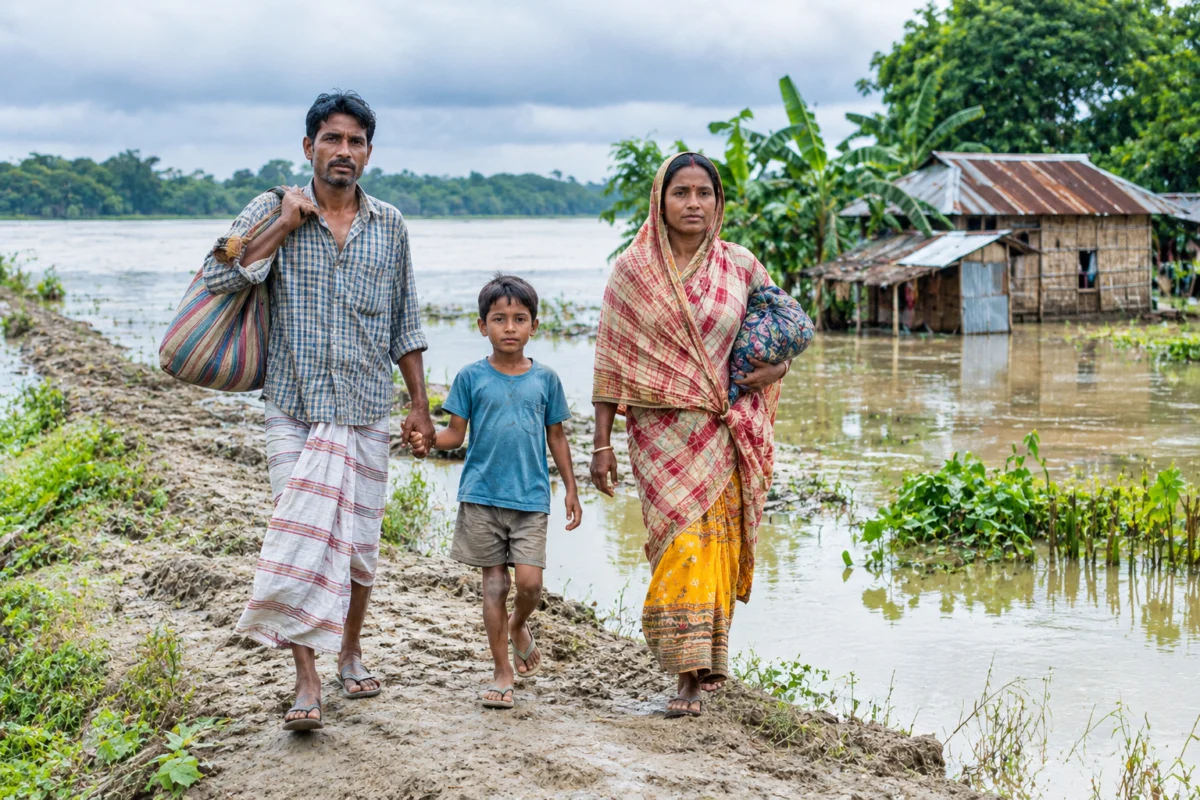
When floods destroy homes, drought makes farming impossible, coastal erosion eats away at land or repeated storms damage livelihoods, people may have little choice but to move. This movement is often described as climate migration. It is already happening in different parts of the world, and it raises important questions about housing, jobs, public services, disaster preparedness and the future of vulnerable communities.
Climate migration does not always mean crossing an international border. Many people move to a nearby town, a safer district or another part of their own country. Some leave temporarily and return after a disaster, while others may never be able to rebuild their lives in the place they left.
This guide explains what climate migration means, why people move, how it differs from disaster displacement and refugee movement, what the latest figures tell us, and why the issue matters to India and Assam.
What Is Climate Migration?
Climate migration refers broadly to the movement of people that is influenced partly or significantly by climate-related changes and environmental conditions. These can include sudden events such as floods, cyclones and wildfires, as well as slower changes such as rising sea levels, coastal erosion, prolonged drought, water scarcity and declining agricultural productivity.
The term covers different forms of movement. A family may evacuate for a few days during a cyclone, move to a nearby city after repeated crop losses, or relocate permanently because their home or livelihood is no longer safe. Climate factors often interact with poverty, employment, housing, conflict, public services and family decisions.
For this reason, climate change is rarely the only reason a person moves. It can increase existing pressures and make it harder for people to remain where they live.
Why Are People Leaving Their Homes?
People move when environmental risks threaten their safety, income, housing or access to essential resources. Common climate-related drivers include:
- Flooding: River floods, flash floods and coastal flooding can destroy houses, crops, roads and local businesses. Repeated floods may make recovery increasingly difficult.
- Cyclones and severe storms: Strong winds, heavy rainfall and storm surges can damage homes, fishing equipment, farmland and public infrastructure.
- Drought and water scarcity: Long periods with insufficient rainfall can reduce crop yields, dry up water sources and weaken livestock-based livelihoods.
- Sea-level rise: Higher sea levels can increase coastal flooding, erosion and saltwater intrusion into freshwater and agricultural land.
- Extreme heat: Dangerous temperatures can make outdoor work harder, affect health and reduce the productivity of agriculture and other climate-sensitive jobs.
- Land and river erosion: Erosion can remove homes and farmland, leaving families without a secure place to live or work.
- Changing growing conditions: Shifts in rainfall, temperature and seasons can make traditional farming or fishing less reliable over time.
How Does Climate Change Influence Migration?
Climate change can influence migration through both sudden disasters and gradual environmental changes. A cyclone may force people to evacuate immediately. By contrast, declining soil moisture or repeated crop losses may gradually reduce a household’s income until moving becomes a practical necessity.
Climate-related hazards do not affect everyone equally. A household with savings, insurance, secure land rights and access to transport may recover more easily than a family living in an informal settlement or depending on rain-fed farming. The same flood can therefore result in temporary evacuation for one household and long-term displacement for another.
The Intergovernmental Panel on Climate Change (IPCC) finds that climate hazards can act as direct and indirect drivers of involuntary migration and displacement. It also notes that most climate-related displacement and migration occurs within national borders.
Climate Migration, Disaster Displacement and Refugees: What Is the Difference?
These terms are connected, but they do not mean exactly the same thing. Understanding the difference is important when reading news reports and statistics.
| Term | Meaning | Example |
|---|---|---|
| Climate migration | Movement influenced partly or significantly by climate-related conditions, which may be temporary or permanent and voluntary or constrained. | A farming household relocates after repeated drought reduces its income. |
| Disaster displacement | Forced movement caused by a disaster or hazard. It may be temporary or prolonged, and can happen within a country or across a border. | Residents evacuate after a cyclone or major flood. |
| Internal displacement | People are forced to leave their homes but remain within their own country’s internationally recognised borders. | A family moves from a flood-affected district to another district in the same country. |
| Refugee | A person who meets the legal definition under applicable international refugee law, generally involving crossing an international border and a well-founded fear of persecution for specified reasons. | A person fleeing persecution who crosses into another country and qualifies for refugee protection. |
The expression climate refugee is often used in everyday discussion, but climate change alone does not create a separate, universally recognised refugee status under the 1951 Refugee Convention. People displaced across borders in a climate-related context may still have protection needs under other applicable legal frameworks, depending on their circumstances and the law in the countries concerned.
What Do the Latest Global Figures Show?
Climate-related movement is difficult to measure because people may move more than once, disasters can have several causes, and official records do not always identify climate change as a factor. It is therefore important to distinguish between the number of displacement movements during a year and the number of people still living away from their homes at a particular date.
The Internal Displacement Monitoring Centre (IDMC) reported that weather-related disasters triggered 27 million internal displacements across 138 countries and territories in 2025. At the end of that year, 13.6 million people were living in internal displacement due to disasters. These are different measures: one counts movements during the year, while the other is a snapshot of people still displaced at year-end.
IDMC also reported that the total number of people living in internal displacement from all causes, including conflict and disasters, stood at 82.2 million at the end of 2025. That total should not be described as the number of climate migrants. Not every disaster is climate-related, and conflict remains a major driver of displacement.
The figures show why reliable data matters. They help governments identify high-risk areas, plan evacuation systems, protect livelihoods and support people who cannot safely return home.
Where Is Climate Migration Happening?
Climate-related mobility is not limited to one continent or one type of environment. Examples include:
- South Asia: Floods, cyclones, river erosion, heat, water stress and coastal risks can affect communities that depend on farming, fishing and informal work.
- Small island states: Sea-level rise, coastal erosion, saltwater intrusion and storm impacts create difficult long-term planning challenges for some island communities.
- The Sahel and other dry regions: Rainfall variability, drought and pressure on land and water resources can affect farming and pastoral livelihoods.
- Coastal Southeast Asia: Flooding, storms, erosion and changing conditions in delta regions can affect homes, fisheries and agricultural production.
- North America and other developed regions: Wildfires, hurricanes, floods and extreme heat can also force people to evacuate or relocate.
Not every person affected by a climate hazard migrates. Some remain because they choose to, because they have the resources to adapt, or because they cannot afford to move. People who are unable to leave a dangerous area are sometimes described as experiencing involuntary immobility.
What Could Happen in South Asia by 2050?
The World Bank’s Groundswell research has examined how slow-onset climate impacts could influence internal migration under different development and emissions scenarios. Its 2021 regional analysis estimated that South Asia could see an average of 35.7 million internal climate migrants by 2050 under a pessimistic reference scenario. The report also presented lower estimates under more inclusive development and more climate-friendly scenarios.
These are scenario-based projections, not a prediction that a fixed number of people will definitely move. They focus on internal migration associated with factors such as water availability, crop productivity and sea-level rise. The results depend on future emissions, development choices, adaptation and local conditions.
The World Bank’s wider Groundswell analysis estimated that up to 216 million people across six world regions could move within their own countries by 2050 without strong climate and development action. The same analysis found that early action could substantially reduce the scale of projected internal climate migration.
Why Climate Migration Matters to India
India experiences a wide range of climate and disaster risks, including river floods, cyclones, heatwaves, drought, coastal erosion and landslides. These hazards affect homes, agriculture, transport, health and access to basic services. Movement may be temporary, seasonal or long term, depending on the severity of the impact and the ability of households to recover.
The IDMC’s 2025 Global Report on Internal Displacement recorded 5.4 million disaster displacements in India during 2024. This is a count of displacement movements, not necessarily 5.4 million different people, and it should not be treated as a climate-migration total. It nevertheless illustrates the scale of disaster-related movement that authorities and communities must prepare for.
India’s climate mobility challenges include:
- Flood-prone river basins where homes, roads and farmland can be repeatedly affected.
- Coastal communities exposed to cyclones, storm surges, erosion and saltwater intrusion.
- Rural households whose income depends on rainfall-sensitive farming and livestock.
- Urban areas that receive people seeking safer housing, jobs and services after environmental shocks.
- Workers who move seasonally or temporarily when local livelihoods become unreliable.
Climate Migration and Assam: Floods, River Erosion and Livelihoods
Assam offers an important example of how environmental hazards can influence movement within a region. Seasonal flooding, riverbank erosion and damage to agricultural land can disrupt homes, schools, roads, livestock and local livelihoods. Families affected by repeated erosion may lose not only a house but also farmland and the social networks that support their daily lives.
When a household is displaced by a flood, it may first move to a temporary shelter, a nearby village, a relative’s home or a higher area. If the original settlement remains unsafe or land is permanently lost, the family may need to relocate for a longer period. Some people move to nearby towns in search of work, education, health services and more stable housing.
It is important not to label every person moving from rural Assam to a town as a climate migrant. Employment, education, marriage, family needs and other economic or social factors also influence migration. Climate hazards may be one factor among several.
Better flood forecasting, embankment planning, erosion-risk mapping, resilient housing, accessible relief and livelihood support can reduce the pressure on families to move in distress. Where relocation is necessary, it should involve affected communities and protect access to land, work, education and public services.
What Challenges Do Climate Migrants Face?
Leaving home does not automatically lead to safety or a better standard of living. People who move after a disaster or environmental change may face several difficulties:
- Loss of housing and property: Families may leave behind homes, land, livestock, tools and personal belongings.
- Uncertain employment: Skills based on farming, fishing or local trades may not easily translate into work in a new location.
- High living costs: Rent, transport, food and healthcare can be more expensive in towns and cities.
- Education disruption: Children may have to change schools or miss classes during repeated moves.
- Health and safety risks: Overcrowded housing, poor sanitation, heat and limited healthcare can create new problems.
- Loss of community ties: Relocation can separate families from neighbours, cultural practices, support networks and familiar places.
- Documentation and land-rights issues: People who lose land or move informally may struggle to prove ownership or access assistance.
Can People Be Forced to Stay in Climate-Risk Areas?
Yes. Migration requires money, transport, information, social connections and somewhere to go. The poorest households may be unable to move even when their homes and livelihoods are under serious pressure. Older people, people with disabilities, children and those with limited support may face additional barriers.
This is why climate policy must not assume that everyone can simply relocate. Protecting people who want to remain, supporting those who need to move and planning safe relocation for places that become uninhabitable are all part of a fair response.
How Can Governments Reduce Climate-Related Displacement?
Climate migration cannot be addressed through emergency relief alone. Governments need to combine disaster risk reduction, climate adaptation, social protection and long-term development.
- Early warning systems: Timely flood, cyclone and heat alerts give people more time to prepare and evacuate safely.
- Resilient infrastructure: Safer homes, roads, drainage, shelters and water systems can reduce damage and protect essential services.
- Livelihood diversification: Training, alternative income opportunities and access to finance can reduce dependence on a single climate-sensitive livelihood.
- Local adaptation: Better water management, crop choices, soil protection and coastal planning can help communities remain safely where possible.
- Planned relocation: When staying is no longer safe, relocation should be voluntary where possible, well planned, adequately funded and designed with affected communities.
- Support in destination areas: Towns and cities need housing, schools, healthcare, transport and employment planning for new residents.
- Reliable data: Governments need clear information about who is moving, why they move, where they go and what support they need.
Is Climate Migration Always a Bad Thing?
Not necessarily. Moving can be a way for people to protect their families, find work, access education or diversify income. Seasonal and planned migration can help households manage environmental and economic risks, especially when people have safe transport, fair employment and access to services.
The greatest concern is forced movement under unsafe conditions, when people have little time, few choices and inadequate support. The aim of climate policy should be to reduce avoidable displacement while making necessary movement safer and more dignified.
Frequently Asked Questions
What is the main cause of climate migration?
There is no single cause. Floods, storms, drought, extreme heat, sea-level rise, coastal erosion and changing water or agricultural conditions can all influence decisions to move. Economic and social factors often interact with environmental pressures.
Are climate migrants the same as climate refugees?
No. Climate migrant is a broad descriptive term. Climate refugee is often used informally, but climate change alone does not create a separate, universally recognised refugee status under the 1951 Refugee Convention. Legal protection depends on the facts and applicable law.
Do climate migrants usually move to another country?
Most climate-related displacement and migration occurs within national borders. People often move to nearby safer areas, towns or cities rather than crossing an international border.
How many people are displaced by climate-related disasters each year?
The number changes from year to year. IDMC reported 27 million internal displacements triggered by weather-related disasters in 2025. This counts movements, including repeat movements, and is not the same as the number of unique people or a count of all climate migrants.
Could climate change cause migration in Assam?
Flooding, riverbank erosion and damage to livelihoods can contribute to temporary or longer-term movement in Assam. However, individual migration decisions usually involve several factors, including work, education, family needs and access to services.
Can climate migration be prevented?
Not every movement can or should be prevented. Better adaptation, early warnings, resilient infrastructure and livelihood support can reduce forced displacement. When relocation is necessary, safe and planned options can protect people’s rights and well-being.
Final Thoughts
Climate migration is not simply a story of people leaving one place for another. It is about homes, livelihoods, safety, family choices and the ability of communities to adapt to changing environmental conditions. The latest displacement data shows that weather-related disasters continue to force millions of movements each year, while longer-term pressures can make some places harder to live in. Governments can reduce avoidable displacement by investing in adaptation, early warning systems, resilient infrastructure and fair relocation planning. For India and flood- and erosion-prone regions such as Assam, understanding these connections is essential to protecting communities and planning for the future.
Sources and Further Reading
The following reports and organisations provide data, research and policy guidance on climate-related mobility, disaster displacement and adaptation.
| Source / Organisation | Information covered | Official link |
|---|---|---|
| Internal Displacement Monitoring Centre (IDMC) | Latest global internal displacement data, disaster-related movements and climate-related displacement analysis. | 2026 Global Report on Internal Displacement |
| International Organization for Migration (IOM) | Climate mobility, migration governance, local adaptation and community responses. | World Migration Report 2026: Addressing Climate Mobility |
| World Bank | Scenario-based projections of internal climate migration and policy options to reduce future pressures. | Groundswell: Climate Migration by 2050 |
| Intergovernmental Panel on Climate Change (IPCC) | Scientific assessment of climate hazards, migration, displacement and vulnerability. | AR6 Working Group II: Health, Wellbeing and the Changing Structure of Communities |
| Indian Council of World Affairs (ICWA) | Climate migration risks, regional vulnerabilities and policy considerations for India and South Asia. | Climate Migration: A Recognised Reality Without Adequate Frameworks |