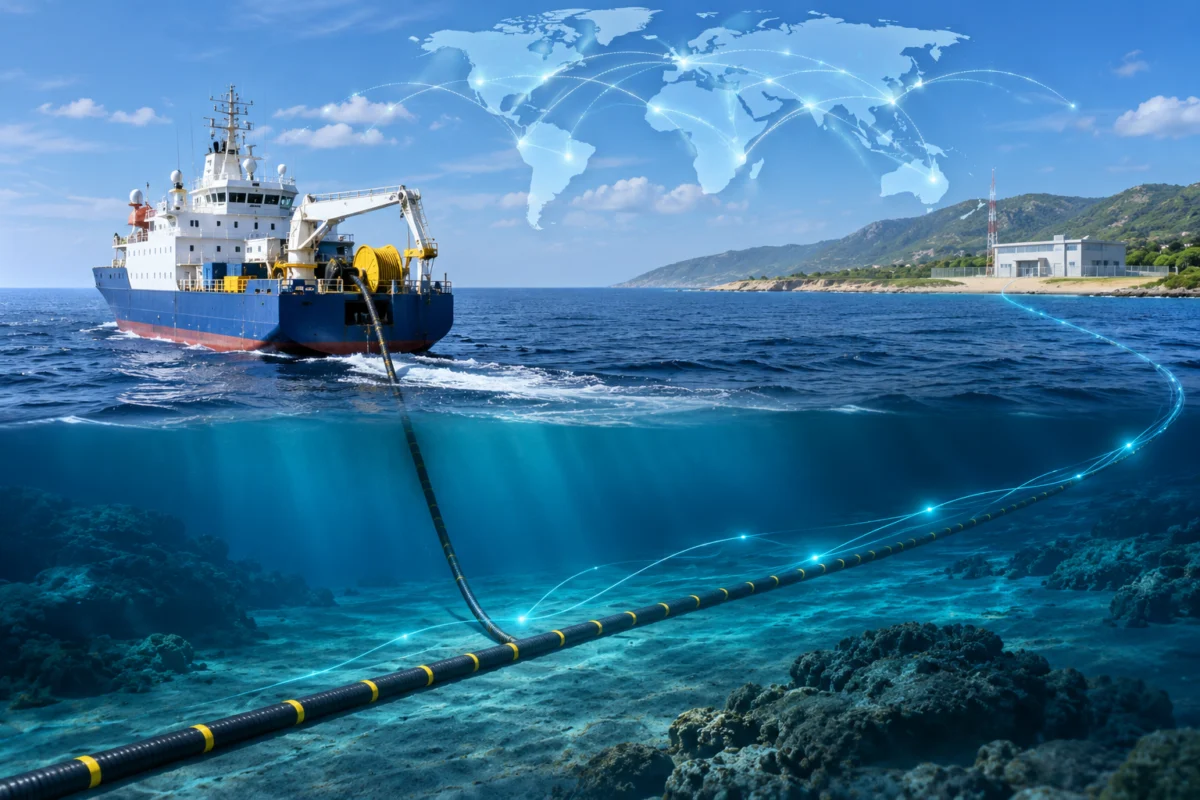
When you send a message, join a video call, stream a film or access a website hosted in another country, your data may travel through a network of fibre-optic cables laid across the ocean floor. These undersea internet cables are a hidden part of the infrastructure that keeps the modern world connected. They link continents, countries, data centres and telecommunications networks, carrying enormous volumes of information every day.
Although satellites receive much of the attention in discussions about global connectivity, submarine fibre-optic cables carry the vast majority of international internet data. Understanding how they work helps explain why cable routes, landing stations, repairs and backup connections matter to ordinary internet users, businesses and governments.
What Are Undersea Internet Cables?
Undersea internet cables, also called submarine communication cables, are fibre-optic cables installed on or beneath the seabed to connect telecommunications networks in different countries. They carry digital information as pulses of light through extremely thin strands of glass or optical fibre.
At each end, the cable connects to a cable landing station on land. From there, terrestrial fibre networks carry the data to internet service providers, mobile networks, data centres and other destinations. A submarine cable is therefore not a separate internet by itself. It is one important part of the wider network of interconnected systems that make the internet work.
The International Telecommunication Union (ITU) describes submarine cables as critical infrastructure for international connectivity. Its overview explains that these systems support services such as financial transactions, cloud computing, video communication and government networks.
How Do Undersea Internet Cables Work?
The basic process is similar to sending information through a fibre-optic connection on land, except the cable travels across the seabed between coastal landing points.
- Your device sends data: A phone, computer or server creates digital information, which travels through a local Wi-Fi, mobile or wired network.
- The data reaches a network provider: Routers and other equipment direct the information through the provider’s network towards its destination.
- Traffic reaches a cable landing station: If the route to the destination uses a submarine cable, the data is handed to equipment at a coastal landing facility.
- Light travels through optical fibres: The information is transmitted as light signals through the glass fibres inside the submarine cable.
- Repeaters support long-distance transmission: Optical amplifiers installed along many long-distance cable systems compensate for signal loss so data can travel across ocean basins.
- The data reaches another landing station: At the destination coast, the signal is connected to terrestrial networks and routed towards the receiving server or user.
- The response travels back: Internet communication is generally two-way, so the return data follows available network routes, which may use the same cable system or another path.
The actual route is selected by network operators using routing policies, capacity, performance, commercial arrangements and available connections. A message does not necessarily travel through the geographically shortest cable route.
What Is Inside a Submarine Internet Cable?
The most important part of a modern submarine communications cable is the optical fibre. The fibres carry information as light. Around them are protective and supporting materials designed to keep the delicate glass strands safe during installation and throughout their service life.
The exact construction varies according to the water depth, seabed conditions and expected hazards. A typical cable may include:
- Optical fibres: Very thin glass strands that transmit digital information using light.
- Protective tubes and layers: Materials that help protect the fibres from moisture and mechanical stress.
- Strength members: Components that help the cable withstand tension during installation and repair.
- Electrical conductor: Many long-distance systems include a conductor used to supply power to underwater repeaters.
- Insulation and outer sheath: Layers that protect internal components from seawater and environmental exposure.
- Armouring: Steel wires or other protective structures may be added, particularly in shallow water where fishing gear and ship anchors create greater risks.
Not every cable has the same number of protective layers. Deep-ocean sections may use a relatively lightweight design, while sections closer to shore often need heavier protection or burial in the seabed.
Why Do Submarine Cables Need Repeaters?
Light signals weaken as they travel through optical fibre over long distances. On many long submarine routes, optical repeaters are installed at intervals to amplify the signals and maintain reliable transmission. These devices are powered through the cable system and are engineered to operate under high pressure and difficult underwater conditions.
Repeaters are not the same as ordinary internet routers or Wi-Fi extenders. They are specialised optical equipment designed for continuous operation in a sealed underwater environment. The spacing and design depend on the cable system, fibre technology and transmission requirements.
What Are Cable Landing Stations?
A cable landing station is a secure facility on the coast where a submarine cable connects to equipment on land. It is a critical link between the undersea fibre route and national or regional telecommunications networks.
Inside a landing station, equipment manages optical transmission, power feeding, monitoring and connections to terrestrial networks. The cable may first come ashore through a protected beach manhole or underground duct before reaching the station.
Landing stations are important because the international cable does not connect directly to every home or mobile phone. Data must pass from the landing station through inland fibre infrastructure, data centres and network providers before reaching end users.
Why Does the World Depend on Undersea Internet Cables?
The ITU says submarine cables carry approximately 99% of the world’s internet traffic. This widely cited estimate illustrates how important these systems are for international data exchange. They support far more than social media and entertainment.
- Everyday internet services: Websites, messaging, video calls, online gaming and streaming depend on interconnected international networks.
- Cloud computing: Businesses access software, storage and computing resources hosted in data centres across borders.
- Banking and finance: International payments, trading platforms and financial communications rely on dependable connectivity.
- Business operations: Companies use global networks for customer support, collaboration, logistics and data exchange.
- Research and education: Universities and research institutions share large datasets and collaborate internationally.
- Government services: Public institutions use international networks for communication and digital services.
For countries that import digital services, participate in international trade or host data centres, reliable submarine connectivity is an important part of economic infrastructure.
What Happens When an Undersea Internet Cable Breaks?
A cable fault can reduce the capacity available on a route or interrupt connectivity between particular locations. However, one damaged cable does not automatically mean that an entire country loses internet access. Networks may reroute traffic through other submarine cables, terrestrial links or alternative landing stations if sufficient capacity is available.
Users may notice slower connections, higher latency, congestion or interruptions to particular services. The effect depends on which cable is affected, how much traffic it carries, how many alternative routes exist and whether those routes have spare capacity.
Network operators monitor cable systems and coordinate repairs. The ITU’s technical guidance explains that faults can be located using monitoring systems and measurements, after which specialist cable ships recover the damaged section for repair.
How Are Damaged Submarine Cables Repaired?
Repairing a cable in the ocean is a specialised marine engineering operation. The process depends on the fault location, water depth, sea conditions and the type of cable involved.
- Detect and locate the fault: Operators use system monitoring and technical measurements to identify the affected cable section.
- Plan the repair: A repair team reviews the route, sea conditions, permits, equipment and safety requirements.
- Send a cable repair ship: A specialised vessel travels to the fault location with trained crew and repair equipment.
- Recover the cable: Grapnels or remotely operated equipment may be used to bring the cable to the surface. The method depends on the depth and conditions.
- Replace or splice the damaged section: Technicians remove the faulty portion and join in a replacement length using specialised procedures.
- Lower and test the repaired cable: The repaired section is returned to the seabed and the system is tested before normal service is restored.
Repairs can take time because ships, weather windows, permits and specialised equipment must all be available. ITU Recommendation G.971 provides technical guidance on cable installation, fault localisation, recovery and sea repair.
What Can Damage Undersea Internet Cables?
Submarine cables are designed to withstand harsh underwater conditions, but they are not impossible to damage. Many faults occur in areas where human activity overlaps with cable routes.
- Ship anchors: Anchors dragged across the seabed can snag or cut cables, particularly near busy coastal areas.
- Fishing activity: Certain fishing equipment can catch or damage cables in exposed areas.
- Underwater landslides: Seabed movement can place stress on cables or break them.
- Earthquakes: Seismic activity can damage cables, especially near fault zones and steep underwater terrain.
- Construction and marine operations: Offshore infrastructure work can create risks if cable routes are not properly identified and protected.
- Equipment faults: Components can fail over time, even when the cable is protected from external damage.
Route surveys, protective armouring, burial in suitable shallow-water sections, monitoring and international coordination all help reduce these risks.
Are Undersea Cables More Important Than Satellites?
Submarine cables and satellites serve different roles in global connectivity. Fibre-optic cables provide enormous capacity for moving data between continents and are central to international internet infrastructure. Satellites can provide connectivity to remote locations, aircraft, ships and areas where terrestrial networks are unavailable or difficult to build.
Satellites are also useful for resilience and backup in certain situations. However, they do not replace the capacity and economics of submarine fibre systems for the majority of international data traffic. Modern networks use a combination of undersea cables, terrestrial fibre, mobile networks and satellite links.
How Do Undersea Cables Affect Internet Users in India?
India’s international internet connectivity depends on submarine cable systems that connect the country to other regions. Cable landing facilities on the coast link international routes to domestic telecommunications networks. From there, traffic travels through national fibre infrastructure to internet providers, data centres, businesses and users.
For someone using the internet in Guwahati, Assam or another inland city, the undersea cable is only one part of the journey. Data may travel over domestic fibre networks to a coastal landing station, cross an ocean through a submarine cable and then move through another country’s network to reach a website or cloud service.
If a major international route is disrupted, network providers may shift traffic to alternative paths. The impact on users depends on the amount of spare capacity and the routes available at that time. This is why diverse cable routes and resilient domestic networks matter.
Why Are Submarine Cables a Strategic Global Asset?
Because submarine cables support communications, finance, cloud services and government networks, they are considered critical infrastructure. A major outage can affect businesses and public services across multiple countries. Their importance has increased as economies rely more heavily on digital services and international data exchange.
Governments, telecommunications companies and international organisations work on cable protection, route diversity, repair coordination and better monitoring. The European Union Agency for Cybersecurity (ENISA) has also examined the technical and security importance of subsea cable infrastructure.
Protecting these systems is not only a technical issue. It also involves maritime safety, international cooperation, infrastructure planning and clear procedures for responding to faults.
Frequently Asked Questions
How deep are undersea internet cables?
Depth varies considerably. Some cables are installed in relatively shallow coastal waters, while deep-ocean routes can reach several thousand metres below sea level. The design and protection methods change according to the depth and seabed conditions.
Are undersea internet cables buried under the ocean floor?
Not all of them. Cables are often buried or given additional protection near shore, where anchors and fishing activity create greater risks. In many deep-sea areas, cables are laid directly on the seabed.
How thick is an undersea internet cable?
There is no single thickness. Cable diameter depends on its construction and the level of protection required. Deep-water cables can be relatively thin, while armoured coastal sections are thicker and heavier.
Can fish or sharks bite internet cables?
Modern submarine cables are engineered with protective layers, and animal damage is not considered the main everyday cause of cable faults. Human activities such as anchors and fishing gear are important risks, along with natural seabed events and equipment failures.
Does a broken submarine cable stop the internet worldwide?
No. The global internet uses many cable systems and alternative routes. A break can affect particular connections or create congestion, but traffic may be rerouted when other paths have sufficient capacity.
How long does it take to repair an undersea cable?
There is no fixed repair time. It depends on the fault location, water depth, weather, ship availability, permits and the complexity of the damaged section. Some repairs can be completed relatively quickly, while difficult cases take longer.
Who owns undersea internet cables?
Ownership varies. Cable systems may be owned by telecommunications companies, consortia of operators, technology companies or other infrastructure investors. Some systems have multiple owners and landing partners.
Final Thoughts
Undersea internet cables are one of the most important and least visible parts of modern global infrastructure. They carry the light signals that connect continents, support international business and keep digital services communicating across borders. Their operation depends on specialised fibre technology, coastal landing stations, careful route planning, monitoring and repair ships. The next time you stream a video, join a meeting or open a website hosted overseas, remember that your data may be travelling through a fibre-optic cable resting thousands of metres beneath the ocean.
Sources and Further Reading
The following official and technical resources provide further information about submarine cable infrastructure, its operation, resilience and importance to India.
| Source / Organisation | Information covered | Official link |
|---|---|---|
| International Telecommunication Union (ITU) | Global role of submarine cables, international data traffic, cable risks and resilience. | Submarine Cable Resilience |
| ITU-T Recommendation G.971 | Technical features of optical-fibre submarine cable systems, installation, monitoring, fault localisation and repair. | General Features of Optical Fibre Submarine Cable Systems |
| European Union Agency for Cybersecurity (ENISA) | Subsea cable security, vulnerabilities, incidents and the importance of protecting landing stations and cable routes. | Subsea Cables: What Is at Stake? |
| Telecom Regulatory Authority of India (TRAI) | India’s submarine cable connectivity, regulatory context and the role of cable infrastructure in international communications. | Submarine Cable Infrastructure and India |