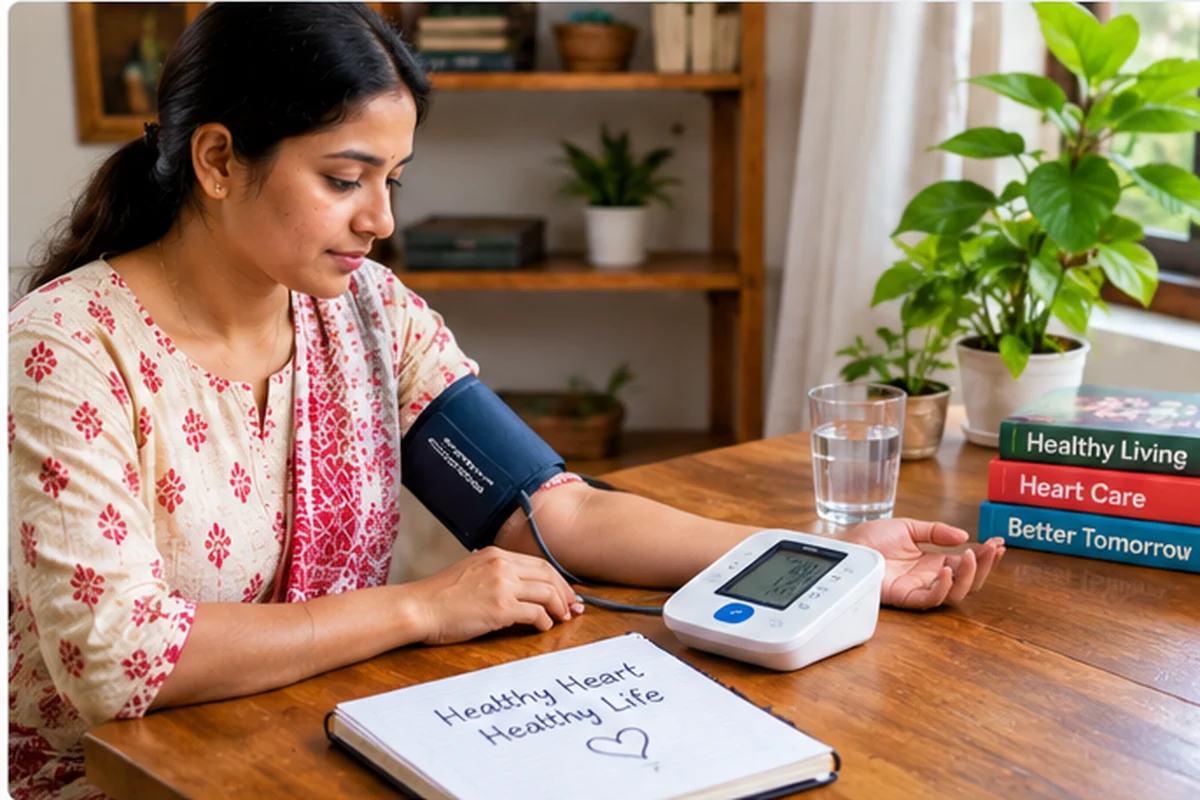
Checking blood pressure at home can help adults and their doctors understand whether readings are consistently high, whether treatment is working and whether clinic readings differ from measurements taken during everyday life. However, the result is useful only when the device and technique are suitable. A cuff that is too small, measuring over clothing, talking during the reading or taking a measurement immediately after tea, coffee or exercise can produce misleading results.
Indian hypertension guidance published for 2025–2026 recommends a structured home-monitoring method using a validated automatic upper-arm monitor. This guide explains how to choose a device, select the right cuff, prepare for a measurement, sit correctly, record readings for seven days and understand when a high result needs medical attention. It is intended for adults. Children, pregnancy and some heart-rhythm conditions need separate clinical guidance.
What is blood pressure?
Blood pressure is the force of circulating blood against the walls of the arteries. A reading is written as two numbers, for example 120/80 mmHg:
- Systolic pressure (top number): The pressure in the arteries when the heart contracts and pumps blood.
- Diastolic pressure (bottom number): The pressure in the arteries when the heart relaxes between beats.
Blood pressure changes throughout the day with activity, stress, sleep, pain, caffeine, medicines and other factors. One reading is only a snapshot. Doctors interpret a pattern of properly taken readings together with a person’s age, medical history, risk factors and examination.
Why check blood pressure at home?
Many people with high blood pressure do not feel unwell. Measuring it accurately is one of the only ways to identify persistently raised readings. Home blood-pressure monitoring can help a clinician:
- Confirm whether raised clinic readings are also present at home.
- Identify possible white-coat hypertension, when readings are higher in a medical setting.
- Check whether blood pressure is controlled during ordinary daily life.
- Review the effect of prescribed treatment over time.
- Make decisions using a series of readings rather than one isolated result.
Home monitoring does not replace a medical consultation. Do not diagnose yourself, start a blood-pressure medicine, change its dose or stop treatment based only on a home reading.
Which blood pressure monitor should you buy?
For most adults measuring blood pressure at home, choose a validated automatic device that uses an upper-arm cuff. The 2025–2026 Indian hypertension guideline recommends validated automated upper-arm monitors and says wrist and finger devices are not recommended for routine home measurement because they can be less reliable.
| Monitor type | Guidance |
|---|---|
| Automatic upper-arm monitor | Preferred for routine home monitoring when the specific model has been validated and the cuff fits the user’s arm. |
| Wrist monitor | Not the preferred choice. Readings are sensitive to wrist position and are less reliable for routine use. |
| Finger monitor | Not recommended for routine blood-pressure measurement. |
| Smartwatch or cuffless device | Do not assume that a smartwatch estimate is equivalent to a validated upper-arm blood-pressure measurement. Ask a clinician before relying on such readings. |
| Manual monitor | Can be used by a trained person with the correct cuff and stethoscope technique, but is usually less convenient for unsupervised home monitoring. |
Check that the exact model has been independently validated for blood-pressure measurement. A product being digital, popular or sold by a recognised brand does not by itself prove clinical validation. Ask a doctor, nurse or pharmacist to help check the model and demonstrate its use. Take the device to a clinic occasionally so its readings and your technique can be compared with professional equipment.
How to choose the correct cuff size
Cuff size is important. A cuff that is too small can produce a reading that is falsely high, while an excessively large cuff may produce an inaccurate result in the other direction. Use the manufacturer’s arm-circumference range printed on the cuff or monitor manual.
- Measure the circumference of the upper arm at the midpoint between the shoulder and elbow, following the manufacturer’s instructions.
- Compare the measurement with the monitor’s small, standard, large or extra-large cuff range.
- Choose a cuff that includes your arm measurement within its stated range.
- Use a suitable cuff for the arm rather than forcing a standard cuff to fit.
Indian guidance describes correct cuff sizing in relation to upper-arm circumference. If your arm is outside the cuff range supplied with the monitor, obtain a compatible cuff from the manufacturer or ask a healthcare professional about a suitable device.
What to do before checking blood pressure
Prepare for the measurement so that the reading is not affected by avoidable factors.
- Avoid caffeine, smoking and exercise for at least 30 minutes beforehand. Tea, coffee, tobacco and physical activity can temporarily change blood pressure.
- Empty your bladder. A full bladder can affect the reading.
- Sit quietly for five minutes. Do not start measuring immediately after walking, climbing stairs, rushing or an argument.
- Choose a quiet place. Keep the room comfortable and avoid conversation, television or phone calls during the measurement.
- Use a bare upper arm. Remove thick or tight clothing so the cuff can sit correctly on the skin. Do not roll a sleeve into a tight band above the cuff.
- Use the same arm consistently. At the first clinical assessment, a healthcare professional may check both arms. Follow their advice about which arm to use for later home readings.
Correct sitting position for a blood-pressure reading
Use the same position each time. Small changes in posture can affect the result.
- Sit on a chair with your back supported.
- Keep both feet flat on the floor.
- Do not cross your legs or ankles.
- Rest your arm on a table or armrest so the middle of the cuff is at heart level.
- Place the cuff on the bare upper arm, following the monitor’s alignment marks.
- Keep the lower edge of the cuff about 2–3 cm above the elbow crease, or as shown in the device instructions.
- Keep your hand relaxed and your palm facing upward.
- Do not talk, move or use your phone while the monitor is measuring.
If you are lying down, standing, using a different arm or measuring under special circumstances, record that information and follow the clinician’s instructions. The standard home-monitoring technique uses a seated position with back and arm support.
Step-by-step: how to check blood pressure at home
- Prepare the monitor. Check the batteries or power source, air tube and cuff. Make sure the device is set up according to the manufacturer’s manual.
- Rest for five minutes. Sit quietly with your back supported and feet flat.
- Fit the cuff. Put it on your bare upper arm, following the artery marker and fit instructions. It should be snug but not painfully tight.
- Support the arm. Rest the arm on a table so the cuff is at heart level.
- Start the measurement. Press the start button and remain still and silent until the monitor finishes.
- Record the result. Write down both systolic and diastolic numbers, the date and time, and the pulse if the device displays it.
- Wait at least one minute. Take a second reading without changing your posture or cuff position.
- Record both readings. Do not keep repeating the measurement until you obtain a number you prefer. Follow the planned monitoring schedule.
- Save the readings. Keep the diary or monitor memory and share the record with your healthcare professional.
Do not round the result up or down. Record the numbers exactly as shown by the monitor.
How often should you check blood pressure at home?
The 2025–2026 Indian hypertension guideline describes a structured home-monitoring schedule:
- Measure twice a day: once in the morning and once in the evening.
- In each session, take two readings at least one minute apart.
- Continue for seven consecutive days where possible.
- Record the time and all readings in a diary or device memory.
- Discard the first day’s readings when calculating the average, as advised by the guideline.
- Calculate the average of the remaining readings and share it with your clinician.
The guideline describes morning measurement within about one hour of waking, after urination and before breakfast, and evening measurement before bed. If you take prescribed medicine, follow the schedule given by your doctor; do not delay, skip or change a dose in order to obtain a particular reading.
Some patients may be asked to monitor for fewer days or over a different schedule. Follow the plan given by the treating clinician, especially if you have symptoms, recently changed medication or have a condition that affects blood pressure.
Home blood pressure reading chart: what do the numbers mean?
The following categories reflect the adult classification in the ICMR Standard Treatment Workflow for hypertension. They are a guide to understanding readings, not a self-diagnosis tool. The higher category applies if either the systolic or diastolic number falls into a higher range.
| Adult clinic BP category | Systolic (top) | Diastolic (bottom) |
|---|---|---|
| Normal | Below 120 mmHg | And below 80 mmHg |
| Elevated | 120–139 mmHg | And/or 80–89 mmHg |
| Hypertension Grade 1 | 140–159 mmHg | And/or 90–99 mmHg |
| Hypertension Grade 2 | 160–179 mmHg | And/or 100–109 mmHg |
| Hypertension Grade 3 | 180 mmHg or higher | And/or 110 mmHg or higher |
Important difference between clinic and home readings: the 2025–2026 Indian guideline says a home blood-pressure average above 135/85 mmHg should be considered elevated. Home readings and clinic readings are interpreted using different thresholds. A doctor should review the average and the person’s full clinical situation before diagnosing hypertension or changing treatment.
Example: how to calculate a seven-day home BP average
Suppose a person takes two readings in the morning and two in the evening for seven days. The first day’s readings are set aside, and the remaining readings are averaged as recommended by the guideline.
For example, if the remaining systolic readings average 138 mmHg and the remaining diastolic readings average 87 mmHg, the home average is 138/87 mmHg. This is above the home threshold of 135/85 described in the Indian guideline and should be discussed with a healthcare professional. It does not mean the person should start or change medication without medical advice.
What should you record in a blood-pressure diary?
A simple diary helps the doctor identify patterns and understand unusual results. Record:
- Date and time of each measurement.
- First and second readings, written exactly as displayed.
- Pulse rate, if the device shows it.
- Which arm was used.
- Whether you took your usual medicine and at what time, if your clinician asks you to track this.
- Any symptoms, illness, unusual stress, pain or circumstances that may have affected the reading.
Bring the diary and monitor to your appointment. A clinician can review the average, check the device and compare your home technique with a clinic measurement.
Common mistakes when checking BP at home
| Common mistake | Why it matters | What to do instead |
|---|---|---|
| Measuring straight after walking or climbing stairs | Recent activity may temporarily raise the reading. | Rest quietly for five minutes before measuring. |
| Drinking tea or coffee just before measuring | Caffeine can temporarily affect blood pressure. | Avoid caffeine for at least 30 minutes beforehand. |
| Using a cuff that is too small or too large | An unsuitable cuff can produce an inaccurate result. | Choose the cuff according to your measured arm circumference. |
| Placing the cuff over thick clothing | Clothing can interfere with cuff fit and positioning. | Place the cuff on the bare upper arm. |
| Letting the arm hang down | The cuff may not be at heart level. | Support the arm on a table or armrest. |
| Crossing the legs or sitting without back support | Posture can influence the reading. | Keep the back supported, feet flat and legs uncrossed. |
| Talking or using a phone during measurement | Movement and conversation can alter the result. | Stay quiet and still until the reading is complete. |
| Taking only one reading | A single result may not represent the usual level. | Take two readings at least one minute apart and follow the monitoring schedule. |
| Using a wrist or finger device without clinical advice | Position and device limitations can reduce reliability. | Use a validated upper-arm monitor for routine home measurement. |
| Changing medicine based on one result | Self-adjustment can cause unsafe low or high blood pressure. | Follow your prescriber’s plan and discuss the diary with them. |
When is a blood-pressure reading dangerously high?
A very high reading needs careful attention, particularly when it occurs with symptoms that may indicate damage to the heart, brain, kidneys or other organs.
The ICMR adult hypertension workflow identifies systolic pressure of 180 mmHg or higher and/or diastolic pressure of 120 mmHg or higher as a severe red-flag level when accompanied by symptoms or signs of acute organ damage. These symptoms include:
- Chest pain.
- Severe breathlessness.
- Sudden weakness, difficulty speaking or swallowing, or sudden vision problems.
- Confusion, severe headache or significant visual disturbance.
Call emergency services or go to the nearest emergency department immediately if a very high reading occurs with chest pain, difficulty breathing, fainting, confusion, sudden weakness, speech difficulty or vision loss. Do not drive yourself if you feel seriously unwell.
If a reading is 180 systolic or 120 diastolic or higher but you have no such symptoms, sit quietly and repeat the measurement after at least one minute. If it remains at that level, contact a healthcare professional urgently for advice the same day. Do not take an extra dose of medicine unless your clinician instructs you to do so.
Seek emergency help for serious symptoms even if the monitor shows a lower number. A normal-looking reading does not rule out a heart attack or stroke.
When should you speak to a doctor about home BP readings?
Arrange a medical review if:
- Your seven-day home average is above the threshold advised by your clinician.
- Repeated readings are higher than your usual level.
- Your readings are unexpectedly low and you feel dizzy, weak or faint.
- You have headaches, blurred vision, chest discomfort or breathlessness.
- You are pregnant, have kidney disease, diabetes, heart disease or a history of stroke and need an individual BP target.
- Your monitor repeatedly displays an irregular-heartbeat symbol or error message.
Blood-pressure goals can differ with age, pregnancy, diabetes, chronic kidney disease, heart disease, frailty and other medical conditions. Do not use a general internet chart to decide your personal treatment target.
Who needs special advice before home monitoring?
Most adults can use an upper-arm monitor after learning the correct technique, but some situations need additional guidance:
- Pregnancy: High blood pressure during pregnancy can require prompt obstetric assessment. Follow the maternity team’s monitoring plan and do not rely on general adult thresholds alone.
- Irregular heart rhythm: Some automated monitors may be less reliable in people with atrial fibrillation or other arrhythmias. Ask a clinician which device and method are appropriate.
- Very large or small arm circumference: A standard cuff may not fit. Obtain a device and cuff designed for the arm size.
- Children and teenagers: Adult BP categories and cuff instructions should not be used without paediatric guidance.
- Older adults with dizziness on standing: A clinician may need to check blood pressure in different positions and review the risk of falls.
Can lifestyle changes help control high blood pressure?
Healthy habits can support blood-pressure control, but they do not replace prescribed treatment when medicine is needed. The ICMR workflow identifies high salt intake, inactivity, tobacco, alcohol use and obesity as relevant risk factors.
- Reduce excess salt and highly salted packaged foods. Read food labels and ask your clinician about an appropriate daily salt target.
- Eat a varied diet with vegetables, fruit, pulses, whole grains and suitable protein sources.
- Stay physically active according to your health and your doctor’s advice.
- Maintain a healthy weight where appropriate.
- Avoid tobacco and discuss alcohol use with a healthcare professional.
- Take prescribed medicines consistently and attend follow-up appointments.
- Prioritise sleep and seek help for possible sleep apnoea or persistent stress.
For another practical guide to reducing dietary sodium, read our article on salt substitutes, sodium and stroke risk. People with kidney disease or those taking certain medicines should ask a clinician before using potassium-based salt substitutes.
Frequently asked questions about checking blood pressure at home
How do I check blood pressure at home correctly?
Use a validated automatic upper-arm monitor with the correct cuff. Avoid caffeine, tobacco and exercise for at least 30 minutes, empty your bladder, sit quietly for five minutes, keep your back supported and feet flat, support the arm at heart level, remain silent and take two readings at least one minute apart.
What is the best type of BP monitor for home use?
A validated automatic upper-arm monitor is generally preferred for routine home measurement. Choose a cuff that fits your upper-arm circumference. Wrist and finger devices are not recommended for routine use by the 2025–2026 Indian guideline.
How long should I rest before checking BP?
Sit quietly for at least five minutes before measuring. Avoid exercise, tea, coffee and tobacco for at least 30 minutes before the reading.
Should I take one or two readings?
Take two readings at least one minute apart in each monitoring session and record both. Follow the monitoring schedule recommended by your clinician.
How many days should I check BP at home?
The 2025–2026 Indian guideline describes morning and evening measurements, two readings per session, for seven consecutive days where possible. It advises setting aside the first day’s readings when calculating the average.
What is a normal blood pressure reading for adults?
The ICMR adult workflow classifies a clinic reading below 120 systolic and below 80 diastolic as normal. Home and clinic thresholds differ, and diagnosis should be based on repeated properly measured readings and clinical assessment.
What is the normal home BP range?
The 2025–2026 Indian hypertension guideline says a home average above 135/85 mmHg should be considered elevated. Your personal target may differ based on your health and treatment plan.
Can I check BP immediately after drinking tea or coffee?
It is better to wait at least 30 minutes after tea, coffee or other caffeine before measuring, because these can temporarily affect the reading.
Can I check BP while lying down?
The standard home-monitoring method uses a seated position with the back supported, feet flat and arm at heart level. If your clinician asks you to measure while lying or standing, record the position and follow their instructions.
Is a wrist BP monitor accurate?
Wrist monitors are sensitive to positioning and are not the preferred option for routine home monitoring. A validated upper-arm device is generally recommended.
Is 140/90 high blood pressure?
In the ICMR adult clinic classification, 140 systolic and/or 90 diastolic falls in the Grade 1 hypertension range. A diagnosis is not made from one home reading alone; a healthcare professional should review repeated readings and the person’s clinical condition.
What should I do if my BP is 180/120?
If a very high reading occurs with chest pain, breathlessness, confusion, severe headache, sudden weakness, speech difficulty or vision changes, seek emergency care immediately. If there are no symptoms, repeat the measurement after at least one minute and contact a clinician urgently the same day if it remains that high.
Should I stop my BP medicine if home readings are normal?
No. Do not stop or change prescribed blood-pressure medicine because of one or several normal readings without discussing it with your treating clinician.
Official blood-pressure guidance and resources
| Resource | What it explains |
|---|---|
| ICMR: Standard Treatment Workflow for Hypertension in Adults | Adult BP measurement checklist, classification, monitoring and red-flag signs. |
| Indian Guidelines on Hypertension, 2025–2026 | Home blood-pressure monitoring, cuff choice, measurement technique and home BP threshold. |
| Ministry of Health and Family Welfare, India | National health guidance and programmes. |
| National Health Mission | Non-communicable disease prevention and hypertension-control information. |
Final thoughts
Home blood-pressure monitoring is useful when the device, cuff and technique are correct. Use a validated upper-arm monitor, rest before measuring, sit with proper support and take two readings at least one minute apart. Keep a structured diary rather than relying on a single result, and share the average with your healthcare professional. Never change prescribed medicine on your own. Very high readings with chest pain, breathlessness, confusion, sudden weakness or vision changes require emergency care.
Health information notice: This article is for general education and is not a diagnosis or treatment plan. Blood-pressure targets and treatment decisions should be individualised by a qualified healthcare professional.