XDOF Aims High with New Funding Round, Eyeing $1.2 Billion Valuation
In an exciting development just months after its debut, the startup XDOF is reportedly in late-stage negotiations to secure a Series B funding round, potentially elevating its valuation to a remarkable $1.2 billion. The investment, primarily led by 8VC, highlights the growing interest in teleoperation data for robotics training.
XDOF’s Rapid Growth Draws Investor Attention
Founded in 2024 by UC Berkeley researchers Philipp Wu (CEO) and Fred Shentu (CTO), XDOF made headlines back in June when it secured $70 million in a Series A funding round, with contributions from big-name investors including Thrive Capital and Andreessen Horowitz. Surprisingly, fresh negotiations for a new funding cycle were not on XDOF’s immediate agenda. Yet, the company’s impressive growth—including an annualized revenue nearing $50 million—prompted venture capitalists to approach them with new opportunities.
Details of the Series B Round Remain Unclear
While TechCrunch indicated that the specifics surrounding the total capital being raised and the final valuation remain uncertain, the evolving deal is still in flux and is subject to change. Unfortunately, both XDOF and 8VC have yet to provide official comments on the matter.
Setting the Standard for Robotics Data
XDOF’s mission is to build comprehensive data pipelines and collection tools that even the most advanced AI labs and robotics companies struggle to create independently. Essentially, they are positioning themselves as an outsourced data supply chain vital for the growth of the robotics industry.
A Foundation Built on Research
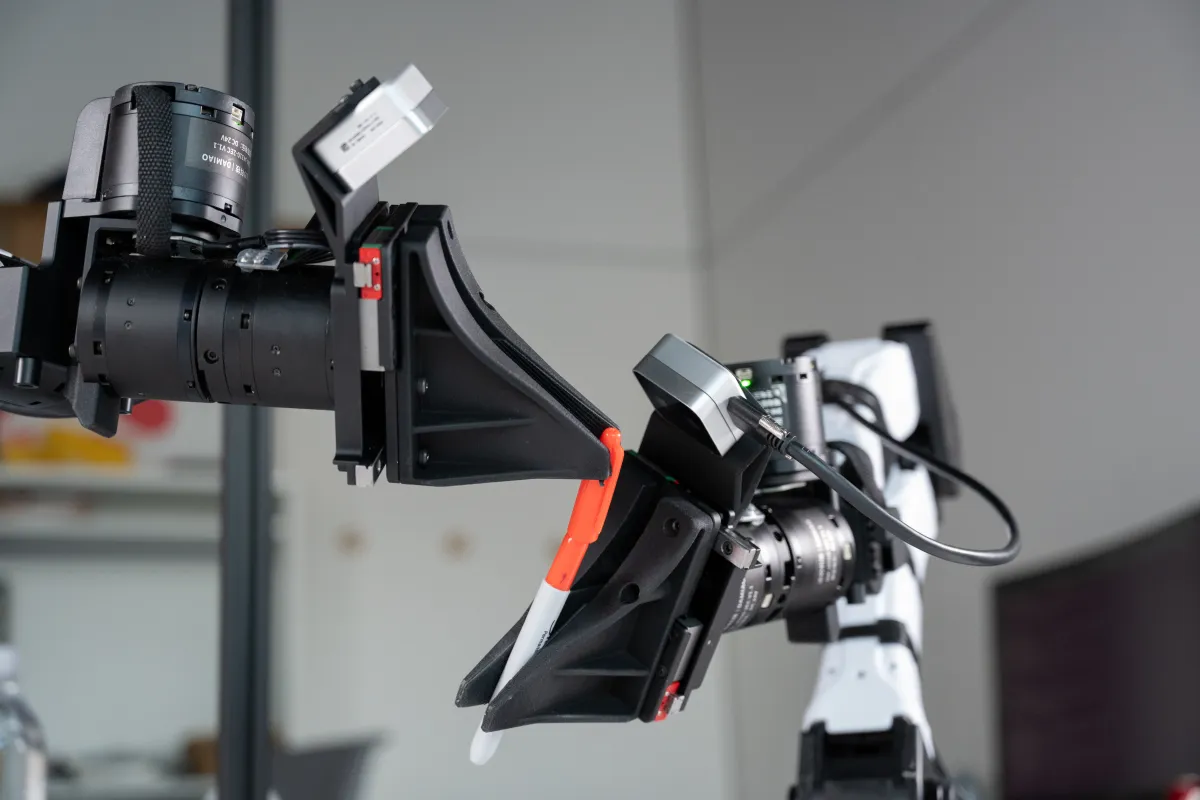
The roots of XDOF can be traced back to Wu’s academic work as a PhD student. Wu faced significant limitations in his research due to a lack of accessible, large-scale datasets crucial for understanding how robots learn. This led him to collaborate with Shentu on a pioneering project known as GELLO—a low-cost teleoperation system that allows a human operator to remotely control a robotic arm, thereby generating valuable training data. Their findings resulted in a paper that has significantly influenced the robotics field.
Partnerships and Future Plans
Investors have begun to compare XDOF to notable data-labeling companies like Scale AI, emphasizing its critical role in providing the necessary datasets for training physically capable machines. In contrast to large language models that capitalize on vast amounts of internet data, physical robots often lack a comprehensive real-world dataset, making efficient data collection paramount.
In collaboration with UC Berkeley’s AI Research lab, XDOF plans to launch what it believes to be the largest assemblage of high-quality robotic training data, aptly named **ABC**. To gather this data, XDOF employs a unique combination of remote robot teleoperation and human data collectors tasked with documenting everyday activities like folding laundry and organizing boxes.
Expanding Global Workforce
To bolster its data collection efforts, XDOF aims to recruit and train teams of diverse data collectors around the world. This includes teleoperators, who will steer robots remotely, and egocentric operators, who will wear specialized sensors to capture motion data. Currently, the startup boasts a roster of 20 clients, including several top-tier AI laboratories.
The Competition Heating Up
XDOF isn’t alone in its mission. Other startups like Mecka AI, along with human-data platforms expanding their focus beyond large language models, such as Scale AI and Micro1, are also venturing into the real-world data collection space for robotics training.
Conclusion
The rapid ascent of XDOF not only signifies the increasing investment in the robotics industry but also underscores the critical importance of data in enhancing machine learning capabilities. As they move forward with their funding rounds and partnerships, the eyes of the tech world are undoubtedly on them.