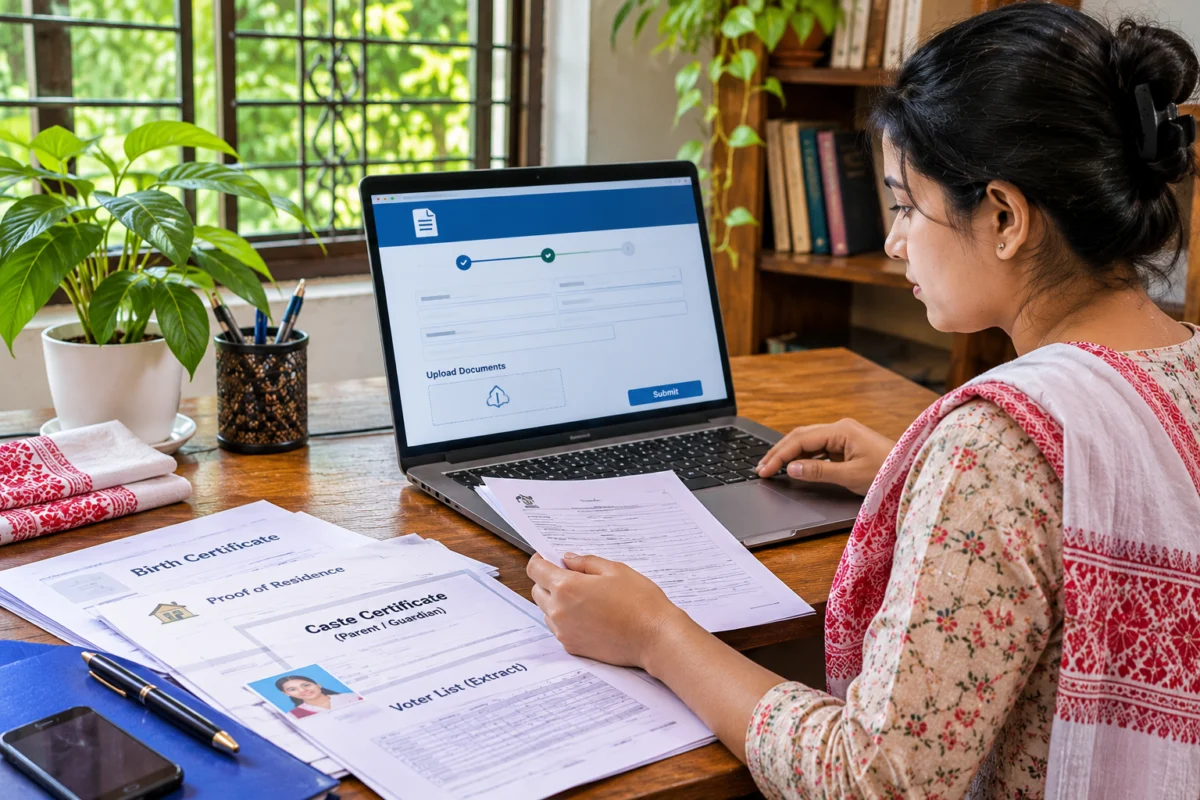
A caste or community certificate issued by the Government of Assam is an important document for eligible applicants seeking to establish their recognised Scheduled Caste (SC), Scheduled Tribe (ST) or Other Backward Classes (OBC/MOBC) status. It may be needed for education admissions, scholarships, recruitment, reservation benefits and other official purposes where the relevant rules accept the certificate.
Assam provides an online application process for SC, ST(P), ST(H), OBC and MOBC certificates. Applicants need to confirm that their caste, tribe or community is recognised in Assam and submit supporting evidence of identity, residence and community status. The Deputy Commissioner of the concerned district scrutinises the application under the State Government’s standard procedure.
This guide explains eligibility, the difference between categories, the official application process, documents, fees, timelines, digital certificates and common problems. It is based on the Government of Assam’s standard procedure dated 8 August 2022, the current State Service Delivery Gateway application form and official district service information checked on 23 November 2026.
What is a caste certificate in Assam?
A caste certificate is an official document that records a person’s recognised caste, tribe or community status under the applicable government list and rules. In Assam, the standard state service covers Scheduled Castes, Scheduled Tribes and the Other Backward Classes/More Other Backward Classes categories.
The certificate is issued after the competent authority verifies the application and supporting records. It is not granted merely because an applicant selects a category on the form or belongs to a community with a similar name. The applicant’s community must be recognised under the applicable list for Assam, and the documents must establish the relevant identity and community connection.
Which caste certificate categories are covered?
The Government of Assam’s standard application form lists the following categories:
| Category | Meaning | Important point |
|---|---|---|
| SC | Scheduled Caste | The applicant’s caste must be recognised as a Scheduled Caste under the applicable constitutional order for Assam. |
| ST(P) | Scheduled Tribe (Plains) | The certificate records the recognised tribe and the relevant area or residence details in Assam. |
| ST(H) | Scheduled Tribe (Hills) | Tribe recognition and the area relation in the applicable Scheduled Tribe order must be checked. |
| OBC | Other Backward Classes | The caste or community must be included in the recognised Assam list. |
| MOBC | More Other Backward Classes | The applicant must belong to a community recognised in the applicable Assam category. |
The categories are not interchangeable. Use the exact caste, tribe, community and sub-category shown in the applicable notified list and the official form. In particular, the Government’s sample ST certificate refers to recognition in relation to an area in Assam. If you are unsure whether your community or sub-group is included, check the official list or ask the competent district authority before applying.
Who is eligible to apply for an Assam caste certificate?
The Assam Government’s standard procedure dated 8 August 2022 sets out three basic eligibility conditions:
- The applicant must be a citizen of India.
- The applicant must be a resident of Assam.
- The applicant must belong to a caste, tribe or community recognised as SC, ST, OBC or MOBC in the State of Assam.
Applicants should confirm that the community name and sub-category match the official notified list. A community recognised in another state may not automatically qualify under Assam’s list. Similarly, a certificate issued by another state should not be assumed to be interchangeable with an Assam certificate for a benefit governed by Assam-specific rules.
For an ST application, check the applicable tribe entry and any area-related conditions. For OBC/MOBC, confirm the community and sub-category recognised by Assam. If the application is for a Central Government examination, admission or benefit, separately check the central list and the certificate format required by that authority.
Official website to apply for a caste certificate in Assam
Use the Government of Assam’s State Service Delivery Gateway or the relevant service link on the Social Justice and Empowerment Department website. The online application form includes a selection for SC, ST(P), ST(H), OBC or MOBC and asks for applicant, parent, ancestral address and supporting-document details.
- Official Assam Caste Certificate Application Form: open the current form and review its fields and attachment requirements.
- Scheduled Caste Certificate service: service information from the Social Justice and Empowerment Department.
- OBC/MOBC Certificate service: service information and access to the official application route.
- Sewa Setu, Government of Assam: the state’s unified citizen-service portal.
- Government of Assam standard procedure: official record of the 8 August 2022 guidelines for SC, ST, OBC and MOBC certificates.
Use the live service link and the instructions shown for your district. A third-party form, old PDF or social-media post should not replace the current government application page.
Documents required for a caste certificate in Assam
The current Assam online form and the State Government’s standard procedure list supporting documents for identity, residence and caste or community status. Prepare clear scans before starting the application. The precise documents required may depend on the applicant’s category, family records and the current instructions of the competent authority.
| Document | Purpose or guidance |
|---|---|
| Recent passport-size photograph | The current online form marks the applicant’s photograph as required and specifies JPG/JPEG/PNG format, a maximum size of 50 KB and a displayed maximum resolution of 155 × 190 pixels. |
| Proof of date of birth | The form lists a birth certificate, Aadhaar card, PAN or admit card issued by a recognised board as options. |
| Proof of residence | The form lists a PRC, Aadhaar, EPIC/voter ID, land document, electricity bill or ration card of the applicant or parent as possible evidence. |
| Father’s caste or tribe certificate | The 2022 standard procedure identifies the father’s caste/tribe certificate as one of the main supporting documents. |
| Recommendation or identification from an authorised community organisation | The standard procedure allows an identification certificate from an authorised caste/tribe organisation notified by the State Government in place of the father’s certificate. |
| Existing caste certificate | The current form includes an option for a recommendation from an authorised organisation or an existing caste certificate, as applicable. |
| Gaonburah or Ward Commissioner report | The online form asks for a report for rural or urban applicants. It notes that the recommendation may be skipped if the applicant’s parents have already been issued SC caste certificates. Confirm applicability for your category and case. |
| Voter list, affidavit or other supporting record | The form provides an additional-document field for records such as voter-list extracts, an affidavit or an existing certificate. |
| Legacy record field | The current form displays a field for legacy data such as NRC 1951 or electoral rolls between 1966 and 1971. Read the note below if these records are unavailable. |
| Scanned application form | The current form includes a required upload field for the scanned application form. |
For most document attachments, the live form displays JPG/JPEG/PNG/PDF formats and a 500 KB maximum per file. The photograph field has its own smaller upload limit. These limits can change; follow the values shown on the application page when you submit.
Important note about NRC and legacy-record documents
The live application form currently displays an attachment field for a copy of legacy data such as NRC 1951 or electoral rolls between 1966 and 1971. However, the Government’s 8 August 2022 standard procedure also says that an enquiry by the authority should be limited to ascertaining caste identity and should not be for production of data or documents such as NRC papers.
Because these two official materials appear different in how the legacy record is presented, applicants who do not have such a document should ask the concerned DC office, authorised service centre or caste/tribe organisation how the field should be handled in their particular application. Do not buy, fabricate or alter a legacy record. The competent authority should clarify what evidence is required under the current procedure.
How to apply for an Assam caste certificate online
The Government of Assam provides a dedicated online application form. The following steps reflect the fields displayed on the official form. The portal’s layout may change, so follow the current instructions shown on screen.
- Confirm your category. Check whether you are applying under SC, ST(P), ST(H), OBC or MOBC. Verify the exact community and sub-category from the applicable Assam list.
- Open the official form. Visit the Government of Assam Caste Certificate application page.
- Select the certificate language. The form lists English, Assamese, Bengali and Bodo.
- Select the category. Choose the correct SC/ST(P)/ST(H)/OBC/MOBC option and the relevant caste, tribe, community and sub-category.
- Enter applicant details. Fill in the applicant’s name, gender, mobile number, date of birth, religion, father and mother’s names and other requested details. The form says status SMS messages are sent to the mobile number provided.
- Add contact details. Enter the email address and other identity details requested by the current form. Aadhaar, PAN and EPIC fields are displayed, but follow the form’s mandatory markers and instructions.
- Enter father or ancestor details. The form asks for the name, relationship and address of the father or ancestor, including state, district, subdivision, Circle Office, Mouza, village, police station, post office and PIN code.
- Enter present and permanent addresses. Complete the address fields for the applicant. If the present address is the same as the permanent address, use the relevant option shown on the form.
- Complete other details. Enter the occupation of the forefather, whether the father’s or mother’s name appears in the voter list and the purpose for obtaining the certificate, as requested.
- Upload supporting documents. Attach the photograph, date-of-birth proof, residence proof, father’s caste certificate or authorised organisation’s recommendation, Gaonburah/Ward Commissioner report where applicable, legacy record if required by the live process and any other relevant documents.
- Upload the scanned application form. Follow the instructions for the scanned form and the page-count fields.
- Review before submitting. Check the selected category, community name, family details, ancestral address, present address and document files. Correct spelling or category errors before submission.
- Complete the captcha and submit. Follow the portal’s final submission instructions and save the acknowledgement or application reference displayed after successful submission.
Do not select a category simply because it appears similar to a community name on an old document. The notified name and sub-category matter. If you cannot find the correct community in the dropdown, contact the issuing authority or authorised community organisation before submitting.
Can I apply through a CSC or Public Facilitation Centre?
Yes. Assam’s e-District service network provides access through Public Facilitation Centres at DC or Circle Offices and Common Service Centres at the village level. The applicant can use an authorised centre for help with the online form, scanning and submission.
- Visit the relevant DC/Circle Office PFC or an authorised CSC that provides the caste certificate service.
- Carry original supporting records and readable copies or scans.
- Tell the operator which category you are applying under and confirm the community name and sub-category.
- Check every applicant, father/ancestor and address detail before the form is submitted.
- Review the uploaded documents and confirm that the correct father’s certificate or authorised organisation’s identification document is attached.
- Ask for the application acknowledgement and an itemised receipt for the service charge and any additional printing or scanning fees.
Do not sign a blank form. Ask the operator to show you the completed information before submission. Keep your acknowledgement number because it is needed for follow-up.
Who issues the caste certificate in Assam?
Under the Government of Assam’s standard procedure, the Deputy Commissioner of the district where the applicant resides scrutinises the application. If the father’s caste certificate is provided and found genuine and bona fide, the Deputy Commissioner may issue the applicant’s certificate. If authenticity is in doubt, the authority may make an enquiry through the authorised caste or tribe organisation.
Where an identification certificate from an authorised caste or tribe organisation is submitted, the standard procedure provides for an enquiry through the Circle Officer if the authority has doubts about its authenticity. The guidelines state that the enquiry is limited to ascertaining caste identity.
Follow the current district service instructions for the designated officer and submission route. The state guideline and current online form are the most useful starting references.
How much does an Assam caste certificate cost?
The Government of Assam’s standard procedure dated 8 August 2022 specifies a service charge of ₹30 per application. An authorised CSC/PFC may also display separate printing or scanning charges depending on the service and the documents handled.
Before paying, check the amount shown on the live application route or confirmed by the authorised service centre. Ask for a receipt. Do not pay an unofficial agent who promises guaranteed approval or a faster certificate.
How long does it take to get a caste certificate?
The 2022 standard procedure states that the ordinary timeline for issuing a caste certificate is 30 days. It may be extended by another 15 days, and the reasons for an extension must be recorded in writing.
Some district service pages also list 30 days for the caste certificate service. The actual time may depend on document verification, category and community checks, district workload and whether the authority requests clarification. Keep the acknowledgement and check the status through the portal or the office that accepted the application.
Will the caste certificate be available digitally?
Yes. The 2022 Assam standard procedure states that certificates are issued online, digitally signed and stored in DigiLocker. It also says that a person who already holds a physical certificate may apply for a digitally signed certificate by uploading the original certificate together with other documents required by the process.
After issue, follow the certificate notification and the DigiLocker instructions. Check that the applicant’s name, community, sub-category, address and issuing authority details are correct. Keep a downloaded copy and verify it through the official channel when presenting it to an institution or employer.
What is the difference between an OBC/MOBC certificate and a Non-Creamy Layer certificate?
An OBC/MOBC caste certificate establishes that the applicant belongs to a community recognised in the relevant Assam category. A Non-Creamy Layer (NCL) certificate is a separate document that establishes eligibility under the applicable non-creamy-layer conditions.
The Assam Social Justice and Empowerment Department lists OBC/MOBC Certificate and Non-Creamy Layer Certificate as separate services. The current Assam NCL application form asks for the digital OBC/MOBC certificate number or an option to apply where the digital certificate is not yet available. It also asks for income evidence in the circumstances specified by the form.
Therefore, an OBC/MOBC certificate alone may not be sufficient where an admission or recruitment notice specifically asks for both caste status and NCL status. Read the exact notice and check whether a separate NCL certificate is required and what validity date is accepted.
- Official Assam Non-Creamy Layer application form.
- Assam OBC/MOBC certificate service.
- National Commission for Backward Classes: Central List of OBCs.
What if your father does not have a caste certificate?
The Assam standard procedure provides an alternative: an identification certificate issued by an authorised caste or tribe organisation notified by the State Government may be submitted in place of the father’s caste or tribe certificate. The live online form also provides a field for a recommendation from an authorised caste, tribe or community organisation or an existing caste certificate.
Before applying, check which organisation is authorised for your specific community and district. A recommendation from an unrecognised association or a private letter may not satisfy the official requirement. Ask the district authority or the relevant notified organisation for the correct format and process.
What if the applicant’s family records contain different names or addresses?
Older family documents may contain spelling variations, initials, a previous surname or a different village or post-office description. These differences should be explained with genuine records rather than silently changed in the application.
- Compare the applicant’s name and parents’ names with the birth certificate, school record and identity documents.
- Check the ancestral village, Mouza, Circle and district against the voter-list or other historical records available.
- Keep a chronological set of documents that shows the relationship between the applicant and the parent or ancestor.
- If a name difference is genuine, ask the issuing office whether an affidavit or additional supporting record is required.
- Do not edit an official certificate, voter-list extract or school record to make it match another document.
What happens if the caste certificate application is rejected?
If an application is rejected or returned, read the reason communicated by the authority. The problem may involve a category mismatch, incomplete documents, an unclear family link, an unsupported community claim or a question about the authenticity of a supporting certificate.
Ask the issuing office for the specific reason and the applicable procedure for correction, re-submission or appeal. Keep the acknowledgement and any written communication. Do not submit a second application with a different caste or community declaration simply to obtain approval.
Important warning about false caste or community claims
The Assam standard procedure includes a penal provision for applications made using false caste, tribe or community status. It states that fraudulent claims or documents can attract penal action and that the Deputy Commissioner may file an FIR if false or fraudulent documents are detected.
Apply only under the community to which you genuinely belong and which is recognised under the applicable Assam list. Use authentic documents and provide accurate information. A caste certificate is an official status document and should not be treated as a formality that can be obtained through an agent.
Common mistakes to avoid
| Common mistake | How to avoid it |
|---|---|
| Selecting a similar but incorrect community name | Check the exact notified caste, tribe or community and sub-category for Assam. |
| Confusing ST(P) and ST(H) | Confirm the correct tribe entry and area-related recognition before applying. |
| Using another state’s certificate without checking Assam requirements | Follow the Assam issuing process and the rules of the authority where the certificate will be used. |
| Submitting an unauthorised association letter | Use only an identification or recommendation from an organisation notified by the State Government. |
| Uploading unclear records | Scan the original documents legibly and follow the current file-size limits. |
| Ignoring the difference between OBC/MOBC and NCL | Check whether the receiving institution or recruitment requires a separate NCL certificate. |
| Assuming an old physical certificate is digitally verified | Check the current process for obtaining a digitally signed certificate if required. |
| Paying an unofficial agent | Use the official portal or authorised CSC/PFC and obtain a receipt. |
Frequently asked questions about Assam caste certificates
What is the official website to apply for a caste certificate in Assam?
Use the Government of Assam’s Caste Certificate application form or access the service through Sewa Setu and the relevant department page.
Who can apply for an Assam caste certificate?
The 2022 State Government guidelines say the applicant must be an Indian citizen, a resident of Assam and a member of a caste, tribe or community recognised as SC, ST, OBC or MOBC in Assam.
Can I apply online for SC, ST, OBC and MOBC certificates?
Yes. The Assam State Service Delivery Gateway provides an online application form with category options for SC, ST(P), ST(H), OBC and MOBC.
Is my father’s caste certificate compulsory?
The standard procedure lists the father’s caste or tribe certificate as one supporting route, but it also allows an identification certificate from an authorised caste/tribe organisation notified by the State Government. Check the live form and your district’s instructions.
Can I apply without an NRC 1951 copy?
The current form displays a legacy-data upload field, while the 2022 standard procedure says caste-identity enquiries should not be for production of NRC papers. Ask the concerned DC office or authorised service centre how to handle the field if you do not have the record. Do not fabricate documents.
What is the fee for a caste certificate in Assam?
The 8 August 2022 standard procedure specifies a service charge of ₹30 per application. Check the current portal or authorised centre for any later change and any separate scanning or printing charges.
How many days does it take to get a caste certificate?
The standard procedure says ordinarily 30 days, with a possible extension of another 15 days where reasons are recorded. The acknowledgement and current district service information should be used to track your application.
Will I get a digital caste certificate?
The standard procedure says certificates are issued online, digitally signed and stored in DigiLocker. Follow the notification and download instructions after approval.
Is an OBC/MOBC certificate the same as an NCL certificate?
No. Assam treats them as separate services. Where a recruitment or admission notice requires Non-Creamy Layer status, you may need the separate NCL certificate in addition to the caste certificate.
Can I use an Assam caste certificate for a Central Government job?
Check the recruitment notification and the relevant Central Government list and certificate format. State recognition and central reservation requirements are not automatically interchangeable. For OBC, check the Central List of OBCs published by the NCBC and the current NCL requirements.
Can I apply through a CSC or PFC?
Yes. Assam’s e-District network provides citizen access through Common Service Centres and Public Facilitation Centres. Confirm that the centre handles the service and ask for an acknowledgement and receipt.
Official Assam caste certificate links
| Government resource | Purpose |
|---|---|
| Assam Caste Certificate form | Complete the current online application for SC/ST(P)/ST(H)/OBC/MOBC. |
| Standard procedure dated 8 August 2022 | Read the State Government’s eligibility, fee, timeline, scrutiny and digital-issue guidelines. |
| Scheduled Caste certificate service | Department service information for SC certificates. |
| OBC/MOBC certificate service | Department service information for OBC/MOBC certificates. |
| Assam Non-Creamy Layer form | Separate application for NCL status where applicable. |
| Sewa Setu | Access Assam government citizen services. |
| Assam e-District/PFC service list | Review supporting-document information and service access through CSC/PFC. |
| NCBC Central List of OBCs | Check the Central Government OBC list for Assam. |
Final thoughts
Applying for a caste certificate in Assam begins with confirming that your community is recognised in the correct state category. Prepare the applicant’s identity and residence proof, the father’s certificate or an authorised community organisation’s identification, and the other records requested by the current application form. Submit online or through an authorised CSC/PFC, save the acknowledgement and monitor the application. If you need OBC/MOBC reservation benefits, check whether a separate Non-Creamy Layer certificate is also required. Use genuine documents and the official government process throughout.