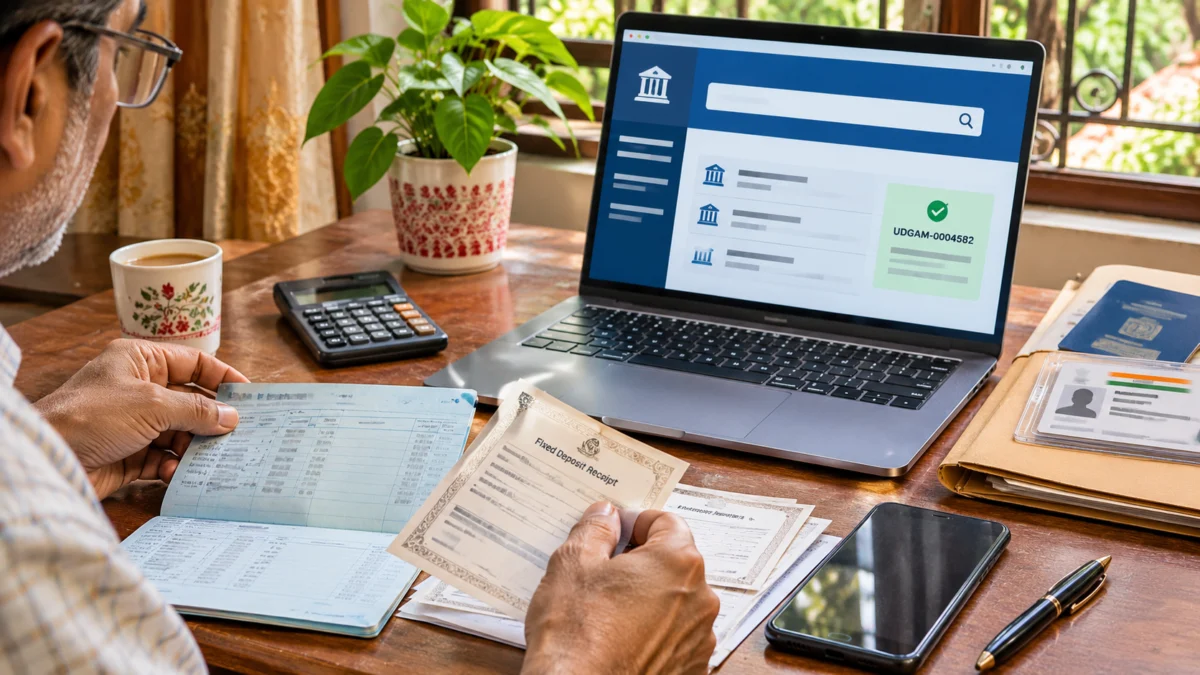
Forgotten savings accounts, matured fixed deposits and old family bank accounts can contain money that the rightful owner has not claimed. The Reserve Bank of India (RBI) created the UDGAM portal to help people search for eligible unclaimed deposits across participating banks from one place. It is particularly useful when an account holder has moved, changed a mobile number, forgotten an old account or passed away without the family knowing about every deposit.
UDGAM stands for Unclaimed Deposits-Gateway to Access inforMation. The portal helps users locate unclaimed deposits and understand the relevant bank’s claim procedure. It does not release money or settle a claim itself. Once a possible deposit is found, the account holder, nominee or eligible legal heir must approach the respective bank and complete its verification process.
This guide explains what UDGAM covers, how to register and search, what a UDRN means, how to claim money from a bank, what families should know when the original depositor has died, and what to do when a search returns no result. The information is based on RBI’s UDGAM and Depositor Education and Awareness Fund information checked on 23 November 2026.
What is the RBI UDGAM portal?
UDGAM is a centralised online search facility developed by RBI. It allows registered users to search eligible unclaimed deposits or accounts across participating banks without having to check every bank website separately. Search results also provide information about the claim or settlement process followed by the respective bank.
The portal covers deposits and accounts that have been transferred to RBI’s Depositor Education and Awareness (DEA) Fund. It does not cover every inactive account in the country, every bank, or every type of forgotten financial asset. The list of participating banks is shown on the live UDGAM portal and may change as banks are added.
Open the official RBI UDGAM portal. Always check the web address carefully before entering your name, mobile number or account-holder details.
What is an unclaimed bank deposit?
Under the RBI’s Depositor Education and Awareness Fund framework, eligible balances in deposit accounts that have not been operated upon for ten years or more, or amounts that have remained unclaimed for ten years or more, are transferred by banks to the DEA Fund. Examples include savings accounts, current accounts, fixed or term deposits and recurring deposits.
For example, a savings account that has not been operated by the depositor for ten years may become eligible for transfer under the applicable rules. A fixed deposit that has matured but remains unclaimed for the prescribed ten-year period may also be transferred. The exact treatment depends on the account and the applicable banking rules.
Transfer to the DEA Fund does not mean that the money becomes the property of RBI or that the customer loses the right to claim it. RBI’s scheme allows the depositor or eligible legal heirs of a deceased depositor to claim the amount through the bank. The bank repays the claimant and then seeks the corresponding refund from the DEA Fund.
Which types of deposits can be searched?
RBI’s DEA Fund FAQ lists a range of balances that may be credited to the Fund when they meet the applicable unclaimed or inoperative period. Common examples include:
- Savings bank accounts: Old savings accounts that have not been operated for the required period.
- Current accounts: Eligible balances in long-unused current accounts.
- Fixed or term deposits: Deposits that remain unclaimed after maturity for the applicable period.
- Recurring deposits: Eligible balances in recurring deposit accounts.
- Other deposit balances: Certain other eligible credit balances and amounts specified under RBI’s scheme.
The RBI FAQ also describes certain other banking balances, such as eligible demand drafts, pay orders, outstanding transfers and some security or margin deposits. Whether a particular amount appears in UDGAM depends on whether it is covered by the DEA Fund and reported by a participating bank.
UDGAM portal vs an inoperative bank account
These terms are related but not identical. An account may be classified as inoperative under the bank’s rules before it reaches the ten-year period relevant to transfer to the DEA Fund. UDGAM is designed to search eligible balances that have been transferred to the Fund, not to act as a general status checker for every dormant or inoperative account.
| Situation | What to do |
|---|---|
| Account is inactive but has not been transferred to the DEA Fund | Contact the bank that holds the account and follow its KYC and reactivation procedure. |
| Eligible deposit has been transferred to the DEA Fund | Search through UDGAM and use the result and UDRN to make a claim with the respective bank. |
| Bank is not listed on UDGAM | Check the bank’s own website for unclaimed deposit information or contact its official branch or customer service. |
| Deposit cannot be found online | Check the search details and ask the bank to investigate using old account or deposit records. |
What information is needed to search UDGAM?
RBI requires a user to register on the portal with a name and mobile number. The search inputs differ for individual and non-individual depositors.
For an individual account holder
For an individual search, the portal asks for the account holder’s name, the bank or banks to search and one or more identifying details. RBI lists these possible identifiers:
- Permanent Account Number (PAN).
- Driving Licence number.
- Voter ID number.
- Passport number.
- Date of birth of the account holder.
RBI’s UDGAM FAQ also says that when the listed identifying information is unavailable, the user can enter the account holder’s address for the search. Use the name and details as they were recorded by the bank wherever possible. Old accounts may have a previous surname, initials, spelling variation or an earlier address.
For a company, trust or other non-individual depositor
For a non-individual account, the search inputs include the entity’s name, the bank or banks to be searched and one or more of the following details:
- Name of the authorised signatory.
- PAN of the entity.
- Corporate Identification Number (CIN), where applicable.
- Date of incorporation.
RBI’s FAQ states that the entity’s address can also be used in place of the other listed identifiers when those details are not available. For an organisation that has changed its legal name, check older registered names and documents when conducting the search.
How to register on the RBI UDGAM portal
Use the official portal and complete the registration process before searching. The screen layout may be updated, so follow the current prompts displayed on the site.
- Open the portal. Go to udgam.rbi.org.in.
- Choose the registration option. Use the new-user or registration option shown on the portal.
- Enter your name and mobile number. Provide the contact details requested for registration. Use a mobile number that you can access during the process.
- Complete mobile verification. Follow the portal’s current verification instructions, including any OTP step shown.
- Sign in. Use the login process displayed on the portal after registration is complete.
- Read the instructions. Review the portal’s search guidance and privacy information before entering account-holder details.
Registration is for using the search service. It does not make the registered user the owner of every deposit found. A person searching for a deceased family member, for example, must still establish their entitlement with the bank during the claim process.
How to search for unclaimed bank deposits using UDGAM
After logging in, select the appropriate depositor type and follow the search fields.
- Select individual or non-individual. Choose the category that matches the original account holder or entity.
- Enter the depositor’s name. For an individual, use the name of the account holder. For an organisation, use its registered or relevant entity name.
- Select the bank. Choose one or more participating banks from the list displayed on UDGAM. Search banks where the person or entity may have held an account.
- Enter an identifier. For individuals, use one or more of the available identifiers such as PAN, voter ID, passport, driving licence or date of birth. For non-individuals, use the authorised signatory, PAN, CIN or date of incorporation as applicable.
- Use the address option when needed. If the listed identity or entity identifiers are unavailable, RBI says the relevant address can be used as an alternative search input.
- Submit the search. Review the details and run the search for the selected bank or banks.
- Review the results carefully. Check the bank name, depositor details and other information displayed. A similar name alone is not enough to establish that a result belongs to you.
- Save the result and UDRN. Use the available download or print option if shown. Keep the Unclaimed Deposit Reference Number and the bank’s claim instructions for the next step.
Try a separate search when a family member used a different spelling, older address or previous name. Do not make assumptions based on a partial name match. The bank must verify the actual account holder or claimant before releasing any amount.
What is UDRN?
UDRN means Unclaimed Deposit Reference Number. RBI explains that it is a unique number generated through a bank’s Core Banking Solution and assigned to an unclaimed account or deposit transferred to the DEA Fund.
The UDRN is designed to help the bank process a successful search result while protecting account and branch details from identification by third parties. Keep the reference number private and provide it only through the bank’s official claim channel. It is not an account number, a password or a code that allows someone to withdraw money without verification.
How to claim unclaimed money after finding it on UDGAM
This is the most important part of the process: UDGAM helps you find the deposit, but the claim must be submitted to the respective bank. RBI’s FAQ explicitly says that claims cannot be settled through UDGAM or directly from RBI. The search result provides information on the bank’s claim or settlement procedure.
- Identify the bank in the result. Note the bank name and the UDRN linked to the potential deposit.
- Read the bank’s claim instructions. Use the claim or settlement link shown in the UDGAM result, or open the bank’s official website independently.
- Contact the bank through an official channel. Ask which branch or centralised claims team handles UDGAM/DEA Fund claims and whether an initial request can be submitted online.
- Prepare the required documents. Collect the UDRN printout or result, identity and address proof, KYC documents and any available passbook, old account number or fixed-deposit receipt. The bank may ask for its own claim form or additional evidence.
- Submit the claim. Follow the bank’s procedure, whether it requires a branch visit, an online submission or another verified channel. Obtain an acknowledgement or claim reference.
- Complete verification. The bank may check the depositor’s identity, account history, nominee or legal-heir entitlement and KYC status before processing the claim.
- Ask for a written status. Keep the acknowledgement and request an explanation if the bank asks for additional documents or clarification.
- Receive the settlement. Once the bank approves the claim, it will pay the rightful claimant through the process it specifies.
The bank, not the UDGAM portal, determines the exact claim documents and verification steps. Do not submit identity papers to an unknown agent who claims to be able to release the deposit faster.
Documents you should keep ready for a claim
There is no single document checklist that applies to every type of deposit, bank and claimant. The bank may need to confirm both the identity of the depositor and the authority of the person making the claim. The following are useful to locate before contacting the bank:
| Document or detail | Why it may help |
|---|---|
| UDRN and UDGAM search result | Helps the bank identify the unclaimed deposit record found through the portal. |
| Account number or old customer ID | Can help the bank trace older account records, if available. |
| Passbook, account statement or fixed-deposit receipt | Provides supporting information about the original account or deposit. Ask the bank what to do if the original is lost. |
| Officially valid identity and address documents | Help the bank complete KYC and verify the claimant. |
| Bank’s claim form | Records the claimant’s details and the request for settlement. |
| Death certificate, where the depositor has died | Usually needed to establish the death before a nominee or eligible legal heir can proceed. |
| Nomination or legal-heir documents, where applicable | Help establish who is entitled to claim under the bank’s deceased-depositor procedure. |
For a claim by the original account holder, the bank may be able to trace the deposit using the UDRN and its records even if the old passbook or fixed-deposit receipt is no longer available. Explain what has been lost and ask for the bank’s accepted alternative procedure. Never create or modify a document to replace a missing original.
How can a nominee or legal heir claim a deceased family member’s deposit?
UDGAM can be useful when a family suspects that a deceased parent, spouse or other relative had an old deposit that was never claimed. The person searching may register with their own mobile number, but the search must use the deceased account holder’s details where the portal asks for the depositor’s name and identifiers.
After finding a possible deposit, contact the bank and state that the original account holder has died. Ask for its deceased-depositor claim procedure and provide the UDRN. The process depends on whether a nominee or survivorship instruction was recorded and whether there is a dispute or other legal complication.
For a claim where a valid nominee or survivor is recorded, RBI’s deceased-depositor directions provide a simplified procedure. The bank should not insist on documents such as a succession certificate, probate or letter of administration from a nominee or survivor in the circumstances covered by those directions. The prescribed documents include the bank’s claim form, death certificate and an officially valid identity and address document of the nominee or survivor.
If there is no nominee or survivorship clause, if there is a Will, if family members disagree or if the claim is otherwise contested, the bank may require additional documents under its applicable policy and RBI instructions. These can vary with the facts and amount involved. Ask the bank for its written checklist rather than assuming that every legal heir can claim using only a death certificate.
When a family member has died, do not share the deceased person’s account information or identity documents in public groups. Use only the bank’s official claim channel.
Can you claim interest on an unclaimed deposit?
RBI’s DEA Fund framework provides for repayment by the bank along with interest where applicable to the interest-bearing deposit. The treatment is not the same for every kind of balance. Interest depends on the original deposit type, the applicable RBI directions and the period for which interest is payable.
Do not assume that every unclaimed balance earns interest at the original fixed-deposit rate indefinitely. Ask the bank for a written settlement calculation showing the principal, applicable interest and relevant dates. RBI’s instructions specify that interest, where payable from the Fund, is calculated for the applicable period from the date the balance was transferred to the Fund to the date of payment. No interest is payable on amounts for which the bank was not required to pay interest.
Is there a time limit to claim money transferred to the DEA Fund?
RBI states that there is no specific time limit prescribed under the DEA Fund Scheme for a depositor or the legal heirs of a deceased depositor to claim a refund. The RBI nevertheless encourages claimants to approach the bank as soon as they become aware of the unclaimed amount.
Finding an old deposit is a reason to start the verification process, not a reason to delay it. Keep the UDRN and claim acknowledgement safe until the bank confirms that the matter is settled.
What if UDGAM does not find your deposit?
A search with no result does not prove that the person never held an account or that no money is due. There are several possible reasons:
- The bank is not participating: UDGAM searches participating banks. Check the current list on the portal and the unclaimed-deposit facility on the bank’s own website.
- The account has not reached the DEA Fund stage: An inactive or inoperative account may still be held by the bank and may not appear on UDGAM.
- The name is different: Try the spelling used when the account was opened, previous surname, initials or another recorded version.
- The identifying details do not match: Check date of birth, PAN, address or other search information against old documents.
- The deposit was in another bank: Search other likely banks, including banks used by the account holder in an earlier city or state.
- The record needs bank verification: Contact the bank with old account documents, deposit receipts or other evidence and ask it to trace the record.
RBI’s UDGAM FAQ says the portal covers deposits that form part of the DEA Fund. It does not promise that every inactive account or every bank deposit will be visible through one search. A bank’s own unclaimed-deposit page is an important alternative check.
What if the bank delays or rejects the claim?
Start by asking the bank for the reason in writing. Give it the UDRN, claim acknowledgement, date of submission and copies of the documents already provided. If the bank says the claimant’s identity or entitlement is unclear, ask for the specific missing evidence and the relevant claim procedure.
If the issue is not resolved through the bank’s internal grievance process, you may use RBI’s Complaint Management System where the complaint is eligible under the RBI Integrated Ombudsman Scheme. First lodge a complaint with the bank and retain its response or the proof of submission. Review RBI’s current eligibility and time-limit conditions before filing through the RBI Complaint Management System.
Do not submit a false claim or claim a deposit merely because the account holder’s name looks similar to yours. The bank must confirm the rightful depositor or legally entitled claimant.
How to protect yourself from UDGAM-related scams
Scammers may use the subject of unclaimed money to send fake RBI messages, UDGAM links or requests for processing fees. A genuine search result does not require you to share an OTP or UPI PIN with another person.
- Use only the official RBI UDGAM web address.
- Do not pay an agent or unknown person to search the portal or guarantee the release of money.
- Never share your bank password, card PIN, CVV, UPI PIN or OTP with a caller claiming to be from RBI or a bank.
- Do not install remote-access or screen-sharing apps at the request of a supposed claims officer.
- Do not scan a QR code or approve a UPI collect request to receive an unclaimed deposit.
- Use the bank contact details published on its official website, not only a number sent in a message.
- Keep the UDRN and personal identifiers private and share them only with the bank through a verified channel.
RBI’s portal provides information and search results; it does not ask a third-party agent to collect money or passwords to release deposits. If you suspect a financial cyber fraud, contact your bank immediately and report it through the official Indian cybercrime reporting channels.
Quick checklist before making a UDGAM search
| What to prepare | Done? |
|---|---|
| Account holder’s full name, including older name variations | Check |
| Likely bank names | Check |
| PAN, date of birth, voter ID, passport or driving licence details where available | Check |
| Old address and previous residential details | Check |
| Passbook, account number or fixed-deposit receipt if available | Check |
| For a deceased depositor, death certificate and nominee or legal-heir information | Check |
| Access to the mobile number used for portal registration | Check |
Frequently asked questions about RBI UDGAM
What is the full form of UDGAM?
UDGAM stands for Unclaimed Deposits-Gateway to Access inforMation. It is the RBI portal for searching eligible unclaimed deposits across participating banks.
Can I claim money directly from the UDGAM portal?
No. UDGAM is a search and information facility. RBI says claims must be made with the respective bank, using the bank’s claim or settlement procedure.
Is UDGAM available for all banks in India?
No. The portal covers participating banks. Check the current bank list on the official portal. If your bank is not listed, use its own unclaimed-deposit search facility or contact the bank.
Can I search for my deceased father’s or mother’s unclaimed deposit?
You can search using the deceased account holder’s details. If a possible deposit is found, the nominee or eligible legal heir must approach the respective bank and complete its deceased-depositor claim process.
What is a UDRN number?
UDRN means Unclaimed Deposit Reference Number. It is a unique reference generated by the bank for an unclaimed deposit transferred to the DEA Fund and helps the bank process a claim.
How many years must a deposit remain unclaimed before transfer to the DEA Fund?
RBI’s scheme covers eligible balances that have remained unoperated or unclaimed for ten years or more, subject to the applicable rules for the account or deposit type.
Is there a last date to claim money transferred to the DEA Fund?
RBI states that the DEA Fund Scheme does not prescribe a specific time limit for a depositor or eligible legal heirs to claim a refund. Claimants are encouraged to approach the bank promptly.
Will I receive interest on an old unclaimed fixed deposit?
Interest may be payable where applicable under the relevant RBI directions and the original deposit terms. Ask the bank for a written calculation because not every type of balance earns interest in the same way.
What should I do if no deposit appears in UDGAM?
Check the depositor’s name and identifiers, search other likely participating banks and use the bank’s own unclaimed-deposit facility. Contact the bank with old account documents if you still cannot locate the deposit.
Can a legal heir claim without a succession certificate?
The documents depend on the account’s nomination and survivorship details and the facts of the claim. RBI’s directions provide a simplified process for nominees and survivors in specified circumstances, but claims without a nominee or with competing claims may require additional documents. Ask the bank for its applicable written procedure.
Official links for finding and claiming unclaimed deposits
| Official resource | Purpose |
|---|---|
| RBI UDGAM Portal | Register and search eligible unclaimed deposits across participating banks. |
| RBI UDGAM FAQ | Understand search inputs, participating banks, UDRN and how claims are settled. |
| RBI DEA Fund Scheme FAQ | Read the ten-year transfer rule, claim rights and interest information. |
| RBI Master Directions on DEA Fund | Review the applicable deposit transfer and refund framework for the relevant bank category. |
| RBI Complaint Management System | Use the RBI complaint route where the bank-related complaint is eligible under the applicable scheme. |
Final thoughts
Old bank deposits do not automatically become lost when they remain unclaimed for years. RBI’s UDGAM portal gives account holders and families a central place to search eligible deposits across participating banks. Start with accurate account-holder details, save the UDRN if a result appears and follow the claim instructions issued by the respective bank. If the depositor has died, use the bank’s nominee or legal-heir procedure. Always verify the bank’s contact details independently and never pay an unknown person to release money.