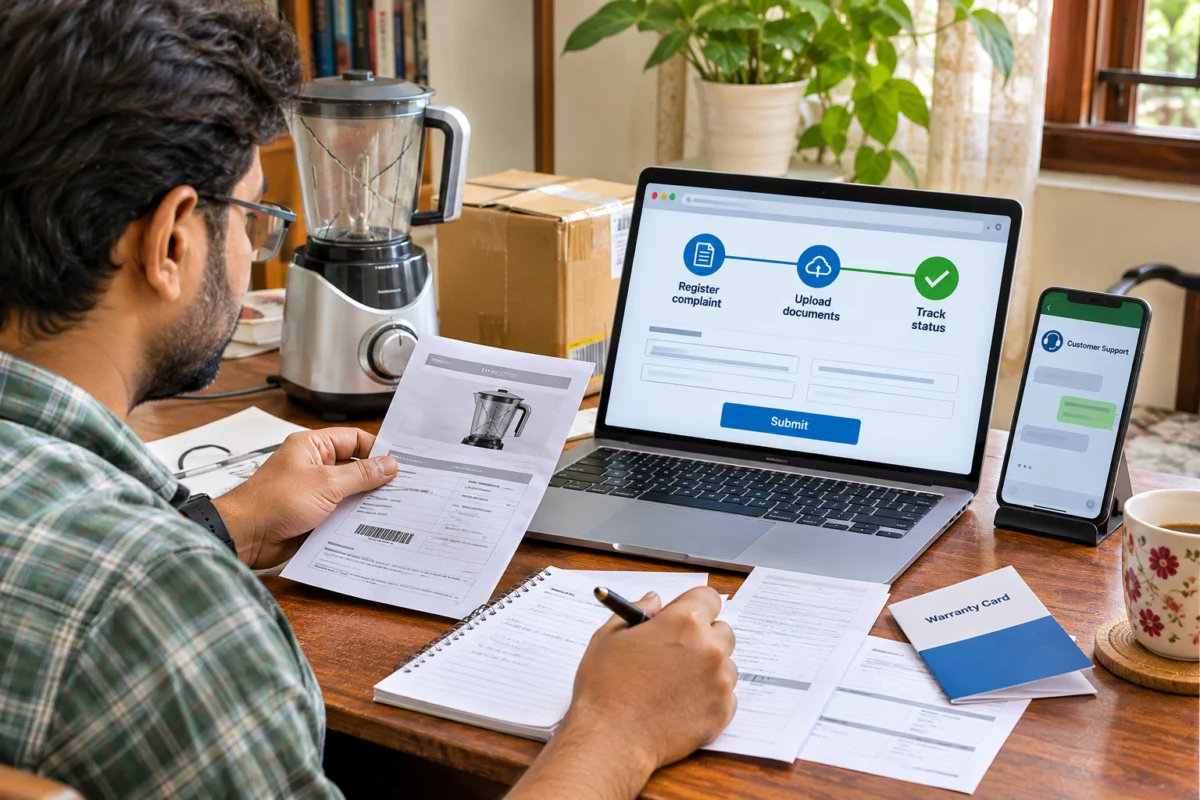
If a company refuses to refund your money, an online seller delivers a defective product, a service provider fails to honour an agreement or you face an unfair trade practice, you may be able to seek help through India’s consumer grievance system. The Government of India provides two important digital routes: the National Consumer Helpline (NCH) for pre-litigation grievance assistance and e-Jagriti for filing and tracking formal cases before Consumer Commissions.
These platforms serve different purposes. NCH forwards a grievance to the concerned company, department or organisation and helps the consumer track its response. e-Jagriti is the government platform for formal consumer-dispute case filing and case management. This guide explains when to use each route, how to submit a complaint, what documents to prepare, how jurisdiction and filing fees work, and what to do if the issue is not resolved.
National Consumer Helpline vs e-Jagriti: what is the difference?
| Feature | National Consumer Helpline (NCH) | e-Jagriti |
|---|---|---|
| Purpose | Pre-litigation consumer grievance and resolution assistance | Formal consumer case filing and management before Consumer Commissions |
| Who handles it? | Department of Consumer Affairs and its grievance network | Consumer Commissions at District, State and National levels through the government platform |
| What happens? | Grievance is forwarded to the concerned company, department or organisation for a response | A formal case is submitted for consideration by the appropriate Consumer Commission |
| Reference | NCH docket number | Case number and case-status information after filing and registration |
| Does it issue a court-like order? | No. NCH is a pre-litigation mechanism and does not replace a Commission order | The Consumer Commission decides the case and may pass an order under the Consumer Protection Act |
| Official website | consumerhelpline.gov.in | e-jagriti.gov.in |
For many ordinary product and service disputes, starting with the seller or service provider and then using NCH is a practical first step. If the grievance is not resolved, or you need a formal adjudication, you can consider filing a case before the appropriate Consumer Commission through e-Jagriti. NCH is not a compulsory precondition for every consumer case, and the two routes should not be confused.
What types of consumer problems can you complain about?
The Consumer Protection Act, 2019 covers complaints relating to goods and services, subject to the definition of a consumer and the other requirements of the law. Examples of common disputes include:
- Defective products: A new phone, appliance, vehicle part or other product does not meet the required quality or promised standard.
- Non-delivery or wrong delivery: An online order is not delivered, is cancelled without a proper refund or arrives as a materially different product.
- Refund and replacement disputes: A seller or manufacturer refuses a remedy that is due under the contract or applicable consumer law.
- Deficiency in services: A paid service is not provided as promised, is performed negligently or falls short of the agreed standard.
- Overcharging: A seller charges more than a legally fixed, displayed or agreed price in circumstances covered by the Act.
- Unfair trade practices: A business uses misleading representations, deceptive selling methods or other practices prohibited by consumer law.
- Misleading advertisements: A product or service is promoted using claims that are false or misleading.
- Housing, travel, telecom, banking or insurance disputes: Some grievances in these sectors may fall within consumer law, although sector-specific ombudsman or regulator processes may also be available.
The Act defines a defect in goods and a deficiency in services, and it includes online transactions within the definition of consumer purchases and services. The correct forum and remedy depend on the facts, the type of transaction and any applicable exclusions.
Who can file a consumer complaint?
A consumer who purchased goods or hired or availed a service for consideration can generally approach the consumer grievance system where the legal requirements are met. The Act also recognises complaints by certain consumer associations, groups of consumers with the same interest (subject to permission where required) and specified government authorities.
There are important limits to the definition. A person who buys goods for resale or for a commercial purpose is generally excluded from the definition of a consumer. The Act contains an exception for goods bought and used exclusively to earn a livelihood through self-employment. Services availed for a commercial purpose are also generally excluded. Whether a particular purchase is personal, commercial or covered by the self-employment exception can depend on the facts.
Online purchases are not excluded merely because they were made through an app, marketplace or website. The Act expressly includes offline and online transactions, teleshopping, direct selling and multi-level marketing within the relevant definitions.
What to do before filing a formal complaint
Before approaching a Consumer Commission, organise the facts and give the business a reasonable opportunity to respond. This often makes the problem easier to explain and creates a clear evidence trail.
- Contact the seller or service provider. Use the customer-care channel, email address or written grievance process published by the business. Explain what went wrong and the remedy you are requesting.
- Keep a reference number. Save the complaint or ticket number, the date you contacted the business and any response received.
- Send a clear written request. State the order or service details, payment amount, problem, earlier attempts to resolve it and the action you expect, such as repair, replacement or refund.
- Set out a reasonable response date. Ask the business to respond within a clear period. Keep the message and proof of delivery.
- Preserve evidence. Save invoices, payment records, product photographs, warranty documents, advertisements, emails, chats and delivery records. Do not rely on screenshots alone when the original email, invoice or downloadable record is available.
- Choose the correct route. Use NCH for pre-litigation grievance assistance or review the e-Jagriti filing requirements if a formal case is appropriate.
A separate legal notice is not automatically required for every consumer complaint. However, a clear written grievance to the business is often useful. For complicated, high-value or time-sensitive matters, obtain legal advice before deciding how to proceed.
How to file a complaint through the National Consumer Helpline
The National Consumer Helpline, managed by the Department of Consumer Affairs, is a pre-litigation grievance redressal mechanism. It receives complaints through several channels, forwards them to the concerned company, department or organisation, and provides a docket number so the consumer can track the response.
Use the official National Consumer Helpline website to begin.
Method 1: Register a complaint on the NCH website
- Open the official portal. Visit consumerhelpline.gov.in and choose the consumer registration or grievance option.
- Register or sign in. Follow the current portal instructions and enter the contact information required for your account.
- Select the complaint category. Choose the appropriate sector, product or service category and the company or organisation involved.
- Describe the problem clearly. Include the purchase or service date, order or invoice reference, payment amount, what went wrong and what you have already done to resolve it.
- Attach supporting documents. Upload the invoice, payment proof, correspondence, photographs or other relevant evidence requested by the portal.
- Submit the grievance. Review the details before submitting and save the docket number generated by NCH.
- Track the response. Use the portal’s grievance-tracking facility to see the latest status and response from the concerned entity.
Method 2: Call the National Consumer Helpline
You can register a grievance by calling the NCH toll-free numbers:
- 1915
- 1800-11-4000
The helpline is available daily except national holidays from 8:00 AM to 8:00 PM, according to the current NCH contact page. Keep your invoice, transaction reference, company name and a short description of the issue ready when you call.
Method 3: Use WhatsApp, SMS, email or UMANG
The NCH also provides multiple channels for registering consumer grievances:
| Channel | Official detail |
|---|---|
| +91 88000 01915 | |
| SMS | Send an SMS to 8800001915 |
| [email protected] | |
| Phone | 1915 or 1800-11-4000 |
| Online portal | National Consumer Helpline |
| UMANG | Search for National Consumer Helpline services in the UMANG portal |
The Department of Consumer Affairs states that NCH supports grievance registration in 17 languages, including Assamese. Use the channel and language that make it easiest to explain the problem accurately.
What happens after registering an NCH grievance?
After a grievance is submitted, NCH generates a unique docket number. It processes the complaint and forwards it to the concerned company, department, regulator or organisation for a response. The consumer can then track the grievance status through the portal.
NCH says the grievance process may take up to 30 days to reach a logical conclusion. This is an indicative process period, not a guarantee that the business will agree to a refund or that every dispute will be resolved. If the response is unsatisfactory, the consumer may choose to approach the appropriate Consumer Commission or another competent forum.
NCH does not pass a binding consumer-court order or award compensation. It is a pre-litigation route intended to help resolve grievances before they become formal disputes.
When should you use e-Jagriti?
Use e-Jagriti when you want to file a formal case before a Consumer Commission rather than only register a pre-litigation grievance. It is the Department of Consumer Affairs’ digital platform for consumer case filing, case-status tracking, case history and access to judgments across the consumer commission system.
Open the official e-Jagriti portal. The portal provides onboarding guidance, help documents, filing videos and support information. Read the current help document for the case type you are filing before preparing your documents.
How to file a consumer complaint through e-Jagriti
The portal’s interface and required fields can be updated. The general flow shown in the official e-Jagriti consumer-complaint guide includes registration, profile details, case details, party information, document upload and final submission or checkout.
- Open e-Jagriti. Visit e-jagriti.gov.in and use the consumer registration or login option.
- Complete your profile. Enter the required personal and contact information. Keep your mobile number and email accessible for portal updates.
- Open the dashboard. After signing in, choose the option to file a new case.
- Select Consumer Complaint. Choose the correct case type from the list. Do not select an appeal, execution application or another case type for a first-time consumer complaint.
- Enter case details. Select the appropriate commission and provide the complaint category, subject, value of consideration and other details requested by the portal.
- Add the complainant and opposite party. Enter the consumer’s details and the correct legal name and address of the seller, service provider, company or other party against whom the complaint is made.
- Add additional parties if necessary. If more than one seller, service provider, manufacturer or other party is legally relevant, follow the portal’s instructions for adding additional or proforma parties. Do not include unrelated parties merely because they appear in a payment chain.
- Upload the filing documents. Add the complaint, affidavit, index, synopsis or list of dates, memo of parties and supporting annexures as requested by the current filing flow.
- Review the complete case. Check names, addresses, case value, relief requested, dates and uploaded files. Correct errors before final submission.
- Complete checkout or payment. Pay the filing fee shown by the portal using an available official payment method, or follow the alternative payment instructions displayed for the selected Commission.
- Submit and save the acknowledgement. Keep the case or filing reference, payment receipt and a copy of the final submitted complaint.
- Track the case. Use the dashboard to monitor filing status, notices, case history, hearing information and orders. Respond to any registry objection or direction within the stated time.
e-Jagriti’s official help documentation shows a step-by-step filing flow for a Consumer Complaint. It also provides help videos, complaint flow guidance and a ticketing option for platform issues. Use the latest documents available under e-Jagriti Help Docs because individual filing requirements may differ by case type and Commission.
Documents to prepare before filing on e-Jagriti
Prepare clear, readable PDF files and organise them in the order requested by the portal. The precise checklist can depend on the complaint and the filing flow. Common documents include:
| Document | Why it is useful |
|---|---|
| Consumer complaint petition | Explains the facts, legal grounds, parties involved and the remedy requested. |
| Index and document list | Helps identify the complaint papers and supporting annexures. |
| Synopsis and list of dates/events | Summarises the dispute and presents the key events in chronological order. |
| Memo of parties | Records the complainant’s and opposite party’s correct names and addresses. |
| Affidavit | Supports the factual statements in the complaint in the form required by the filing rules and portal. |
| Invoice or purchase receipt | Proves the purchase, price, seller and transaction date. |
| Payment proof | Shows payment by card, UPI, bank transfer, wallet or another method. |
| Warranty or service documents | Helps establish promised coverage, contractual terms or service obligations. |
| Emails, chats and complaint tickets | Shows communication with the seller, service provider or customer-care team. |
| Photographs, reports or delivery evidence | Supports allegations about defects, damage, non-delivery or deficient service. |
| Vakalatnama, where applicable | Authorises an advocate to represent the complainant when legal counsel is engaged. |
The e-Jagriti help guide lists filing documents such as an index, proforma, synopsis with list of dates and events, memo of parties, consumer complaint with affidavit and supporting annexures. It may also provide for interlocutory applications and a vakalatnama where applicable. Follow the exact file names, formats, signatures, affidavit and notarisation requirements shown in the live portal and the latest official help document.
Which Consumer Commission should you choose?
India has District, State and National Consumer Commissions. Under the Consumer Protection (Jurisdiction of the District Commission, the State Commission and the National Commission) Rules, 2021, the monetary jurisdiction is based on the value of goods or services paid as consideration. It is not simply the amount of compensation you want to claim.
| Commission | Value paid as consideration |
|---|---|
| District Consumer Commission | Up to ₹50 lakh |
| State Consumer Commission | Above ₹50 lakh and up to ₹2 crore |
| National Consumer Commission (NCDRC) | Above ₹2 crore |
For example, if you paid ₹35,000 for a defective phone and ask for a refund plus compensation, the amount of compensation requested does not by itself move the case to the State Commission. The jurisdictional value is tied to the consideration paid for the goods or services under the applicable rules.
Where can you file the consumer complaint?
The Consumer Protection Act, 2019 allows a District Commission complaint to be filed in a district where one of the relevant territorial connections exists. These include:
- The opposite party ordinarily resides or carries on business or has a branch office or personally works for gain.
- The cause of action arose wholly or partly.
- The complainant resides or personally works for gain.
This means a consumer may not have to travel to the seller’s city simply because the purchase took place there. The place where the consumer lives or works may also provide territorial jurisdiction, subject to the legal requirements. The Act includes corresponding territorial provisions for State Commissions as well.
For online purchases, keep the order confirmation, delivery address, invoice and communication records. They can help establish the transaction and the relevant location. If the case involves multiple opposite parties or a complicated jurisdiction question, check the legal position before filing.
Consumer complaint filing fees in India
The Consumer Protection (Consumer Disputes Redressal Commissions) Amendment Rules, 2022 set the filing-fee table by the value of goods or services paid as consideration. The following is the notified fee schedule. The portal’s checkout screen should be checked before payment in case of a later amendment or case-specific requirement.
| Commission and consideration value | Notified filing fee |
|---|---|
| District: Up to ₹5 lakh | Nil |
| District: Above ₹5 lakh to ₹10 lakh | ₹200 |
| District: Above ₹10 lakh to ₹20 lakh | ₹400 |
| District: Above ₹20 lakh to ₹50 lakh | ₹1,000 |
| State: Above ₹50 lakh to ₹1 crore | ₹2,000 |
| State: Above ₹1 crore to ₹2 crore | ₹2,500 |
| National: Above ₹2 crore to ₹4 crore | ₹3,000 |
| National: Above ₹4 crore to ₹6 crore | ₹4,000 |
| National: Above ₹6 crore to ₹8 crore | ₹5,000 |
| National: Above ₹8 crore to ₹10 crore | ₹6,000 |
| National: Above ₹10 crore | ₹7,500 |
For a District Commission complaint where the value of goods or services paid as consideration is up to ₹5 lakh, the notified filing fee is nil. This does not mean that optional legal representation, document preparation, travel or other personal expenses will also be free. Check the amount displayed by e-Jagriti before completing checkout.
What is the time limit for filing a consumer complaint?
Section 69 of the Consumer Protection Act, 2019 states that a Consumer Commission should not admit a complaint unless it is filed within two years from the date on which the cause of action arose.
The Commission may entertain a complaint after the two-year period if the complainant shows sufficient cause for the delay. The Commission must record its reasons for condoning the delay. Do not assume that sending an email to a company or registering an NCH grievance automatically extends the statutory limitation period for a formal case.
If the dispute is approaching the two-year mark, get legal advice promptly and do not wait for an informal grievance process to finish before checking your limitation position.
What remedies can a Consumer Commission order?
Depending on the facts and evidence, the Consumer Protection Act allows a Commission to grant different forms of relief. Possible orders include:
- Removal of a defect in the goods or deficiency in the service.
- Replacement of defective goods with goods free from the defect.
- Refund of the price or charges paid, with interest where ordered.
- Compensation for loss or injury suffered by the consumer due to negligence or other proven grounds.
- Discontinuation of an unfair or restrictive trade practice.
- Withdrawal of hazardous goods from sale or stopping the supply of hazardous services.
- Corrective or other directions available under the Act in the circumstances of the case.
These remedies are not automatic. The Commission examines the complaint, the evidence, the response of the opposite party and the applicable law before deciding what relief, if any, is justified.
What happens after submitting a case on e-Jagriti?
After submission, the filing may be reviewed for the required information and documents. The Commission decides whether the complaint is admissible. Under the Act, admissibility is ordinarily to be decided within 21 days of filing; if the issue is not decided within that period, the Act provides for deemed admission. This does not mean that the entire case will be resolved within 21 days.
After the case proceeds, the opposite party is given an opportunity to respond. The Commission may consider written evidence, hear the parties, refer suitable disputes to mediation or use other procedures permitted by the Act. The e-Jagriti dashboard can be used to track case details, case history and orders. Check the portal regularly for notices, defects, hearing dates and requests for additional documents.
Common mistakes to avoid when filing a consumer complaint
- Choosing the wrong route: NCH grievance registration and formal Commission case filing are different processes.
- Selecting the wrong Commission: Check the consideration paid and the current pecuniary jurisdiction rules before filing.
- Using an incorrect opposite-party name: Verify the legal entity on the invoice, contract, company website or official business record.
- Submitting a vague complaint: Explain exactly what was promised, what happened, when you complained and what remedy you seek.
- Missing evidence: Keep invoices, payment receipts, emails, screenshots, delivery records and service tickets in a clear sequence.
- Claiming an unrealistic amount without explanation: Connect each requested remedy or compensation amount to the actual loss and supporting evidence.
- Ignoring limitation: Keep the two-year statutory period in mind and obtain advice if the dispute is old.
- Ignoring portal notices: Check e-Jagriti for defects, notices, hearings and requests for additional information after filing.
- Assuming NCH guarantees a refund: NCH forwards grievances and tracks responses, but it does not issue a binding order or guarantee a settlement.
When should you use another grievance or regulator process?
Some disputes fall under sector-specific rules or have a specialist complaint mechanism. For example, banking, insurance, securities, electricity and telecom services may have regulator, ombudsman or appellate routes in addition to consumer-law remedies. Check the relevant regulator’s current process and eligibility before deciding where to file.
If the matter involves an unauthorised bank transfer, UPI fraud, phishing or online financial fraud, report it promptly to your bank and the cyber-fraud helpline at 1930. A consumer complaint is not a substitute for urgent financial-fraud reporting.
Frequently asked questions about filing a consumer complaint online
What is the official website for filing a consumer complaint in India?
Use consumerhelpline.gov.in for NCH pre-litigation grievances and e-jagriti.gov.in for formal consumer cases before Consumer Commissions.
Is National Consumer Helpline the same as e-Jagriti?
No. NCH is a pre-litigation grievance service that forwards complaints to the concerned organisation and tracks its response. e-Jagriti supports formal case filing and case management for Consumer Commissions.
Can I file a consumer complaint without a lawyer?
Consumers can generally file their own complaints. However, a complicated dispute, large claim or legal issue may benefit from advice from a qualified consumer-law professional. Follow the portal’s current document and affidavit requirements.
Can I file a complaint from my home city if the seller is in another state?
The Consumer Protection Act includes territorial jurisdiction where the complainant resides or personally works for gain, subject to the applicable Commission and case requirements. Check the exact jurisdiction before filing.
How much does it cost to file a consumer complaint?
The notified fee depends on the consideration paid for the goods or services and the Commission with jurisdiction. District Commission complaints up to ₹5 lakh have a nil filing fee under the notified schedule. Verify the checkout amount on e-Jagriti before payment.
Is there a time limit to file a consumer complaint?
Section 69 of the Consumer Protection Act sets a general limit of two years from the date the cause of action arose. A Commission may condone delay if sufficient cause is shown and its reasons are recorded.
What is the NCH helpline number?
Call 1915 or 1800-11-4000. The current NCH contact page lists service hours as 8:00 AM to 8:00 PM daily except national holidays.
Can I complain about an online shopping order?
Yes. The Consumer Protection Act includes online transactions in its definition of consumer purchases and services. Keep the order invoice, payment confirmation, delivery proof, seller communication and product evidence.
Does filing an NCH complaint guarantee a refund?
No. NCH forwards the grievance to the concerned organisation and tracks the response. It does not guarantee a particular outcome or issue a binding Consumer Commission order.
What if the company does not respond to NCH?
Keep your NCH docket number and response history. If the grievance remains unresolved, consider filing a formal complaint through e-Jagriti or using another applicable legal or regulatory route.
Can I upload evidence after filing on e-Jagriti?
The portal provides case-management options for subsequent filings and documents, subject to the case stage and Commission instructions. Follow the current portal workflow and any direction issued in your case.
Official consumer complaint links and contact details
| Resource | Official link or contact | Purpose |
|---|---|---|
| National Consumer Helpline | Open NCH | Register and track pre-litigation consumer grievances. |
| NCH telephone | 1915 / 1800-11-4000 | Register a grievance by phone. |
| NCH WhatsApp | +91 88000 01915 | Register a grievance through WhatsApp. |
| NCH email | [email protected] | Contact the Department of Consumer Affairs’ helpline. |
| e-Jagriti | Open e-Jagriti | File and track formal Consumer Commission cases. |
| e-Jagriti help documents | Open Help Docs | Read case-filing instructions and portal workflows. |
| Consumer Protection Act, 2019 | Read the Act | Check consumer rights, complaint procedure, jurisdiction and limitation. |
| Commission jurisdiction rules, 2021 | Read the Gazette notification | Check District, State and National Commission monetary jurisdiction. |
| Filing fee amendment, 2022 | Read the fee notification | Check the notified Consumer Commission filing-fee table. |
Final thoughts
Consumers in India have a digital route to seek redress when a product or paid service does not meet the promised standard. Start by recording the problem and contacting the business. Use the National Consumer Helpline when you want pre-litigation grievance assistance and a docket number. If the dispute needs formal adjudication, check the Consumer Protection Act, the correct Commission jurisdiction, filing fee and limitation period, then use e-Jagriti to submit and track the case. Keep every invoice, message, payment record and acknowledgement, and seek qualified advice when the dispute is complex or time-sensitive.