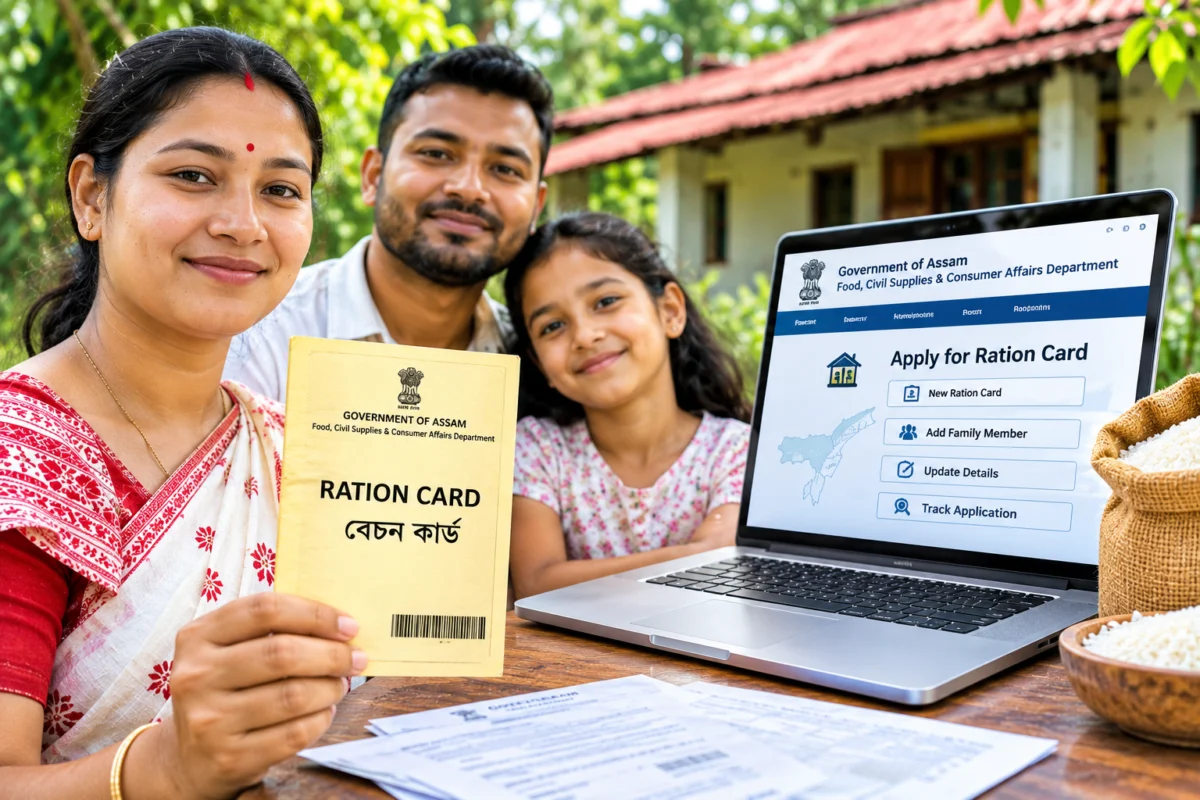

When land is sold, gifted or inherited in Assam, the revenue record should be updated to show the person who has succeeded to the land. This process is commonly called land mutation. In Assam, mutation changes the name recorded in the Record of Rights (RoR), commonly reflected in the Jamabandi, and helps the revenue administration identify the person responsible for land revenue.
The application process depends on how the land changed hands. A buyer with a registered transfer deed follows the deed-based mutation route. A legal heir applying after the recorded landholder’s death follows mutation by right of inheritance and must provide evidence of death and heirship or relationship. The Government of Assam lists both services under Mission Basundhara and publishes separate document checklists and application steps.
This guide explains the difference between the two routes, how to prepare the land details, which documents to collect, how to submit an application through the applicable online service, what happens after submission and how to check the updated Jamabandi. It also explains why mutation should not be confused with a complete legal title investigation. The information is based on Assam Government service pages and published procedures checked on 23 November 2026.
What is land mutation in Assam?
Land mutation is the process of recording a change in the name of the person shown in the land revenue record after a transfer, inheritance or another legally recognised succession. The Jamabandi or Record of Rights is updated so that the revenue record reflects the person recognised for the relevant landholding or share.
For example, if a person buys a parcel through a registered sale deed, the buyer can apply to have the recorded landholder’s entry updated. If the recorded pattadar dies, the eligible legal heir or heirs can apply for mutation by inheritance with the required supporting records.
Assam’s Mission Basundhara service descriptions identify “Mutation by right of inheritance” and “Mutation after deed registration” as separate services. The portal describes mutation as registration of a person’s name in the Record of Rights, or Jamabandi, after inheritance or transfer. View the official Basundhara service list.
Why should you apply for mutation after buying or inheriting land?
- Update the revenue record: The Jamabandi can reflect the person who has succeeded to the land or share.
- Land revenue administration: The revenue record can show the person from whom land revenue is assessed or collected.
- Future land-related applications: An updated record may be needed for later revenue services, partition or correction requests.
- Reduce record mismatches: Updating the record after a sale or inheritance helps avoid a long-standing difference between the deed or succession documents and the revenue entry.
- Maintain family land records: For inherited property, mutation helps record the recognised heirs or the relevant shares in the revenue system.
Mutation is an important revenue-record step, but it is not a substitute for checking the registered deed, inheritance documents, encumbrances, restrictions, boundaries or pending disputes.
Important: mutation does not by itself prove or create ownership title
A mutation entry is made for land-revenue and record-maintenance purposes. The Supreme Court of India has repeatedly explained that mutation in revenue records does not, by itself, create or extinguish title to property. Questions about ownership or competing title claims must be determined through the competent legal process, not solely by relying on a Jamabandi entry.
Before buying land, check the chain of registered deeds, the seller’s authority, the current Jamabandi, land classification, applicable restrictions, encumbrance information, possession and any dispute or court order. Where the title is complicated or family members disagree, consult a qualified property lawyer or the competent revenue authority. Read the Supreme Court’s explanation of the legal effect of mutation entries.
Two main types of mutation in Assam
| Mutation type | When to use it | Main documents |
|---|---|---|
| Mutation after deed registration | When land has been sold or transferred through a registered deed and the buyer’s name needs to be recorded. | Registered deed copy and copy of the No Objection Certificate issued by the Deputy Commissioner, as listed by Basundhara. |
| Mutation by right of inheritance | When a recorded landholder has died and eligible legal heirs seek to update the Jamabandi. | Death certificate, next-of-kin or other accepted relationship/heirship proof, and consent of other heirs opting out where applicable. |
Do not select the inheritance service simply because a family member has informally given land to another relative. Likewise, do not select deed-based mutation if there is no registered deed for the transaction. Use the service that matches the legal basis on which the land or share passed to the applicant.
How to apply for land mutation in Assam after a sale or registered deed
Basundhara describes deed-based mutation as the process of recording a change in the ownership entry after a property has been transferred or sold. The new owner’s name is recorded in the revenue record and land revenue is assessed from the rightful recorded holder. The current service description lists a deed copy and the Deputy Commissioner’s No Objection Certificate as supporting documents.
Documents required for mutation after deed registration
- Registered deed copy: Keep a readable copy of the registered sale deed, gift deed or other registered transfer document relevant to the transaction.
- Deputy Commissioner’s NOC: Basundhara’s published checklist lists a copy of the No Objection Certificate issued by the Deputy Commissioner.
- Land details: Keep the district, Circle, village, Dag number, land schedule and area being transferred ready.
- Deed details: Keep the deed number, registration date and deed value available for the application fields.
- Seller and buyer details: Confirm the recorded pattadar/seller name and the buyer’s full particulars, including name spelling and address.
- Other supporting records: Keep the current Jamabandi, land revenue receipt, identity details and any document specifically requested by the competent office or active portal.
The exact documents shown for a case can depend on the land, transaction and applicable restrictions. Follow the live checklist rather than assuming that every transfer needs exactly the same attachments.
Step-by-step process for deed-based mutation
- Check the current service route. Open the Basundhara official services page and find “Mutation after deed registration”. Read the service guidelines and confirm whether the online application route is currently active for your land and area.
- Confirm the land location. Identify the district, Revenue Circle, rural or urban area, village and Dag number. Check that these details match the registered deed and current Jamabandi.
- Keep the deed and NOC ready. Prepare the registered deed copy and the Deputy Commissioner’s NOC listed in the service checklist. If your transaction was processed under the Composite Land Sale Transfer route, keep the composite application reference and registration details too.
- Enter the land details. The published Basundhara procedure asks for district, Circle, rural or urban selection, village and Dag. The land schedule is populated for the selected Dag, with the area expressed in Bigha, Katha and Lessa.
- Enter seller details. The service procedure includes deed number, deed date, deed value, NOC number and date, seller/pattadar details and the area to be mutated.
- Enter buyer details. Add the buyer/applicant details. Where multiple buyers are involved, follow the portal’s instructions for adding each applicant and entering the relevant share or area.
- Upload the requested files. Upload the deed copy and NOC copy, along with any additional documents requested on the live form.
- Review the application. Check names, deed details, Dag, land area, NOC references and buyer information carefully. Correct mistakes before submission.
- Submit and save the acknowledgement. Complete the declaration and agreement, submit the application and download the generated acknowledgement containing the Application ID where the portal provides it.
- Follow up through the official route. Track the application using the service dashboard or acknowledgement. Respond to any official query or notice from the Circle Office.
These fields are drawn from the published Basundhara Standard Operating Procedure. The portal’s screen names and active intake route may change. If the online “Apply Now” option is not available, contact the concerned Circle Office or District Revenue Branch for the current filing procedure.
What is Composite Land Sale Transfer in Assam?
Assam also published a Composite Land Sale Transfer process to connect the Deputy Commissioner’s land-transfer NOC, property registration at the Sub-Registrar Office and mutation/partition at the concerned Circle Office. Under the 11 November 2022 notification, an applicant can select the composite service with “Auto Mutation” or “Auto Mutation along with Partition”, where the service and land are eligible.
The government notification describes a sequence in which the application is examined by the Lot Mandal and Circle Officer, notice/hearing steps are followed where required, the Deputy Commissioner approves the NOC, the deed is registered at the Sub-Registrar Office and the registration data is sent through the system to Dharitree for mutation. It is not a simple replacement for every land transaction or every district-specific process; confirm eligibility and service availability before relying on it.
How to apply for land mutation by inheritance in Assam
Mutation by right of inheritance is used when the recorded pattadar has died and the eligible legal heir or heirs request that the Jamabandi be updated. The Assam service description says the process follows Section 53A(1) of the Assam Land and Revenue Regulation, 1886. It also lists the documents needed to establish the death and the applicant’s relationship or heirship.
Documents required for mutation by inheritance
| Document | When it is used |
|---|---|
| Death certificate | To establish that the recorded pattadar has died. |
| Next-of-kin certificate | To establish the relationship and identify the legal heirs, as required by the service. |
| Gaon Pradhan certificate | The Basundhara procedure lists a certificate from the Gaon Pradhan for rural areas as an alternative heirship/relationship document in the specified process. |
| Ward member or Executive Officer certificate | For an urban area, the service procedure lists a certificate from the ward member or Executive Officer. |
| Probate from a competent court | Where the application is based on a Will, the Basundhara checklist lists probate from court. |
| Relationship affidavit | The service also lists an affidavit explaining the applicant’s relationship with the deceased person as an accepted document option in the stated checklist. |
| Consent of other next of kin | Where other legal heirs are opting out of mutation, their consent is listed as a conditional document. |
The correct heirship document depends on the family circumstances and the basis of the claim. Do not assume that one family member can be recorded as the sole successor when other heirs have legal interests. Where heirs disagree, a Will is disputed or a succession issue is complicated, get legal advice and follow the competent authority’s written directions.
Step-by-step process for mutation by inheritance
- Open the official service list. Visit Mission Basundhara and locate “Mutation by right of inheritance”. Read the current eligibility and document checklist.
- Prepare the land details. Keep the district, Circle, rural or urban selection, village, Dag number and land schedule ready. The published process uses these details to identify the land in the revenue record.
- Select the recorded pattadar. Choose the deceased landholder’s name in the owner details and enter the area or share for which mutation is requested.
- Add the applicant or applicants. Confirm whether the applicant’s name is already present in the Dag. If not, enter the name in English and Assamese where requested, gender, guardian details, relationship, date of birth, address and mobile number. Add other applicants when required by the case.
- Upload the death certificate. Use a clear copy of the death certificate for the recorded pattadar.
- Upload heirship or relationship proof. Use the next-of-kin certificate, Gaon Pradhan/urban authority certificate, probate where there is a Will, or relationship affidavit as applicable under the service requirements.
- Attach consent where applicable. If other next of kin are opting out of mutation, provide the consent document required by the service.
- Complete declarations and review. Read the declarations, confirm applicant details and land share, and check that the uploaded documents are readable.
- Submit the application. Accept the agreement, submit the form and download the acknowledgement with the Application ID.
- Respond to verification or notice. The Circle Office may check the revenue entry, relationship evidence or consent. Follow any notice, hearing or clarification request through the official process.
- Check the updated record. After the mutation order is passed, use the official Jamabandi/land-record service to check whether the applicant or heirs are recorded correctly.
The published Basundhara SOP states that inheritance applicants enter land details, owner details and applicant details, upload the required files, complete the declarations and download the acknowledgement. It specifies PDF, JPG and PNG uploads up to 2 MB in that SOP. Always follow the size limit shown by the current portal if it differs.
How to check the mutation application status
After submitting the application, keep the acknowledgement and Application ID. The Basundhara website provides a dashboard for checking the status of applications submitted under Dharitree and a track-application facility. Use the official portal rather than a third-party site.
- Open the official Mission Basundhara website.
- Choose the dashboard or application tracking option shown for the relevant service.
- Enter the Application ID or details requested by the tracking page.
- Check whether the application is received, under verification, awaiting clarification, scheduled for hearing, approved or rejected.
- If an objection or query is raised, read the notice carefully and submit the requested information using the instructed channel.
- Save the status page, notice, acknowledgement and any order issued by the Circle Office.
If you filed through an offline Circle Office or a service centre, use the case number or acknowledgement supplied by that office. Ask for written status information if the online dashboard does not show the case.
How long does land mutation take in Assam?
The timeline depends on which service route is used and whether an objection is raised. The Composite Land Sale Transfer notification dated 11 November 2022 states that, after deed registration is complete and the application reaches the Circle Officer through the system, the Circle Officer is to pass the mutation order within seven days of receiving the deed. If an objection is received within that period, a notice and hearing are to follow, with disposal within 45 days from registration of the mutation case under the notification.
That seven-day period is tied to the specified composite process and should not be presented as a guaranteed timeline for every standalone mutation, inheritance case or disputed application. Verification, missing documents, objections, hearing requirements and local procedure can affect the time. Check the service-specific timeline and your application acknowledgement.
What is the fee for land mutation in Assam?
The Mission Basundhara service list currently describes both “Mutation by right of inheritance” and “Mutation after deed registration” as having no user fee under those services. That statement applies to the Basundhara-listed services; it should not be treated as proof that every related land, registration, court, document, stamp-duty or municipal service is free.
For example, stamp duty and registration fees for a deed are separate from the mutation service. A Guwahati Municipal Corporation property-tax mutation is also a separate municipal record process and has its own published checklist and charges. Before paying, check the fee displayed by the relevant government service or obtain confirmation from the competent office and request an official receipt.
What happens if there is an objection or dispute?
If a co-pattadar, family member, buyer, seller or another interested person objects, the revenue authority may issue a notice and conduct a hearing or further verification. A mutation application should not be treated as a way to bypass a genuine inheritance or title dispute.
Keep copies of the notice, your reply, supporting records and any hearing order. Attend the hearing or respond by the deadline stated in the notice. If the disagreement concerns ownership, a disputed Will, competing deeds, fraud or the legal shares of heirs, seek advice from a qualified property lawyer. The revenue authority’s mutation process and a civil court’s decision on title are not the same thing.
Common mistakes that delay a mutation application
| Common problem | What to check |
|---|---|
| Wrong Dag or village selected | Compare the district, Circle, village, Dag and land schedule with the existing Jamabandi and deed. |
| Area or share does not match the deed | Check the area in Bigha, Katha and Lessa and confirm the portion being transferred or inherited. |
| Deed number or date entered incorrectly | Copy the deed details exactly from the registered document. |
| Deputy Commissioner’s NOC not attached | Check the Basundhara deed-mutation checklist and provide the NOC copy where required. |
| Death certificate or heirship proof missing | Use the relevant inheritance checklist and confirm which accepted relationship document applies. |
| Other heirs’ consent is unclear | Do not omit an interested heir. Provide the consent requested by the service or seek legal advice if there is disagreement. |
| Name spelling differs across records | Provide consistent details and ask the Circle Office how to explain genuine variations with supporting evidence. |
| File scan is unreadable or too large | Prepare clear PDF/JPG/PNG files within the current portal’s upload limit. |
| Application was filed under the wrong service | Use deed-based mutation for a registered transfer and inheritance mutation for succession after death. |
How to check the updated Jamabandi after mutation
Once the mutation order is issued, verify the resulting land record rather than relying only on an SMS or verbal confirmation. Assam’s ILRMS/Dharitree and Basundhara services provide ways to view land-record details and Jamabandi information.
- Open the Integrated Land Records Management System (ILRMS) or the official Basundhara land-record link.
- Select the district, Circle and village where the land is located.
- Search using the available Patta, Dag or pattadar details.
- Open the Jamabandi/Record of Rights and check the name, area, share and other entries.
- Compare the updated record with the mutation order and deed or inheritance documents.
- If the entry is still wrong or incomplete, contact the concerned Circle Office and refer to the mutation case number and order.
For a detailed guide to reading Assam land records, see our article How to Check Jamabandi Online in Assam.
Is land mutation in Guwahati the same as GMC property mutation?
Not always. Revenue mutation updates the land revenue record, such as the Jamabandi or Record of Rights, through the relevant revenue authority. Guwahati Municipal Corporation also has a separate property-mutation service for changing the name in the municipal property-tax assessment record after a sale, succession or other transfer.
GMC’s published guidance lists documents such as the updated property-tax receipt, registered sale deed, land mutation order, Jamabandi and Patta, party-related records and applicant ID. It also lists a death certificate and next-of-kin certificate for inheritance cases. The municipal process has its own application route and fee information. If the property is within the GMC area, ask whether you need both revenue-record mutation and municipal assessment mutation. Do not assume one automatically updates the other.
Read Guwahati Municipal Corporation’s mutation guidance.
Official Assam land mutation links
| Government resource | Purpose |
|---|---|
| Mission Basundhara services | View mutation by inheritance, mutation after deed registration and current service checklists. |
| Basundhara Standard Operating Procedure | Read the field-by-field steps for inheritance and deed-based applications. |
| Composite Land Sale Transfer notification | Understand the DC NOC, deed registration, auto mutation and partition flow for the composite service. |
| Mission Basundhara portal | Access current services, application tracking and land-record information. |
| ILRMS, Assam | Access Assam land-record and Jamabandi services. |
| Revenue and Disaster Management Department | Government information on land revenue and related services. |
| Guwahati Municipal Corporation mutation | Separate municipal property-assessment mutation procedure for properties within GMC jurisdiction. |
| Supreme Court order on mutation entries | Understand why revenue mutation entries do not, by themselves, establish legal title. |
Frequently asked questions about land mutation in Assam
What is the official website for land mutation in Assam?
Start with Mission Basundhara and check its service list for mutation by inheritance or mutation after deed registration. You can also use the official ILRMS land-record services to check Jamabandi details.
Can I apply for land mutation online in Assam?
Basundhara publishes online procedures for both inheritance mutation and deed-based mutation. Online service availability can vary by service and application window. Check the current “Apply Now” option and contact the Circle Office if the service is not accepting applications.
What documents are required for mutation after land purchase?
The Basundhara checklist lists a copy of the registered deed and a copy of the No Objection Certificate issued by the Deputy Commissioner. The application also asks for land, deed, seller and buyer details. Follow the live case-specific checklist.
What documents are required for mutation by inheritance?
The published list includes the death certificate, next-of-kin certificate or other accepted certificate from the Gaon Pradhan/urban authority, probate where there is a Will, or relationship affidavit. Consent of other next of kin opting out is conditional where applicable.
Is mutation after inheritance free in Assam?
The Mission Basundhara service list currently shows no user fee for mutation by right of inheritance. Other documents or separate legal and administrative processes may have their own charges, so check the service and obtain an official receipt.
Is deed-based mutation free in Assam?
The Basundhara service list also shows no user fee for mutation after deed registration. Stamp duty, deed registration charges and other transaction costs are separate from the mutation service.
How long does mutation take after deed registration?
The 11 November 2022 Composite Land Sale Transfer notification states that the Circle Officer should pass the mutation order within seven days after receiving the registered deed through that system. If an objection is received, a hearing is required and the notification provides a 45-day disposal limit from registration of the mutation case. This is not a universal guarantee for every mutation route.
Can one legal heir apply for mutation without the consent of other heirs?
The service checklist asks for consent of other next of kin who are opting out, where applicable. The rightful shares and the need for consent depend on the facts and applicable law. If heirs disagree, obtain legal advice and follow the authority’s written directions rather than excluding an interested heir.
Does mutation prove ownership of land?
No. The Supreme Court has explained that mutation entries in revenue records are primarily for fiscal purposes and do not, by themselves, create or extinguish title. Check the deed, succession documents and title history as well.
What is the difference between land mutation and partition?
Mutation records a change in the name of the landholder or successor. Partition divides a jointly held revenue estate into separate shares or holdings, where the applicable service and eligibility conditions are met. A mutation application does not automatically complete every partition request.
Do I need separate mutation for property tax in Guwahati?
GMC has a separate municipal property-mutation process for its assessment records. Ask GMC whether that is required in addition to revenue mutation for your property.
How can I check whether mutation has been completed?
Use the Basundhara/Dharitree application tracking facility with your application reference, then check the updated Jamabandi through the official ILRMS or land-record service. Compare the entry with the mutation order.
Final thoughts
Land mutation in Assam should be completed through the correct process after a registered transfer or inheritance. Buyers should keep the deed and the Deputy Commissioner’s NOC listed by Basundhara ready, while heirs should prepare the death certificate and accepted heirship or relationship proof. Enter the land details carefully, save the application acknowledgement and check the final mutation order and updated Jamabandi. Remember that mutation updates the revenue record; it does not replace a full investigation of legal ownership or settle a disputed title by itself.