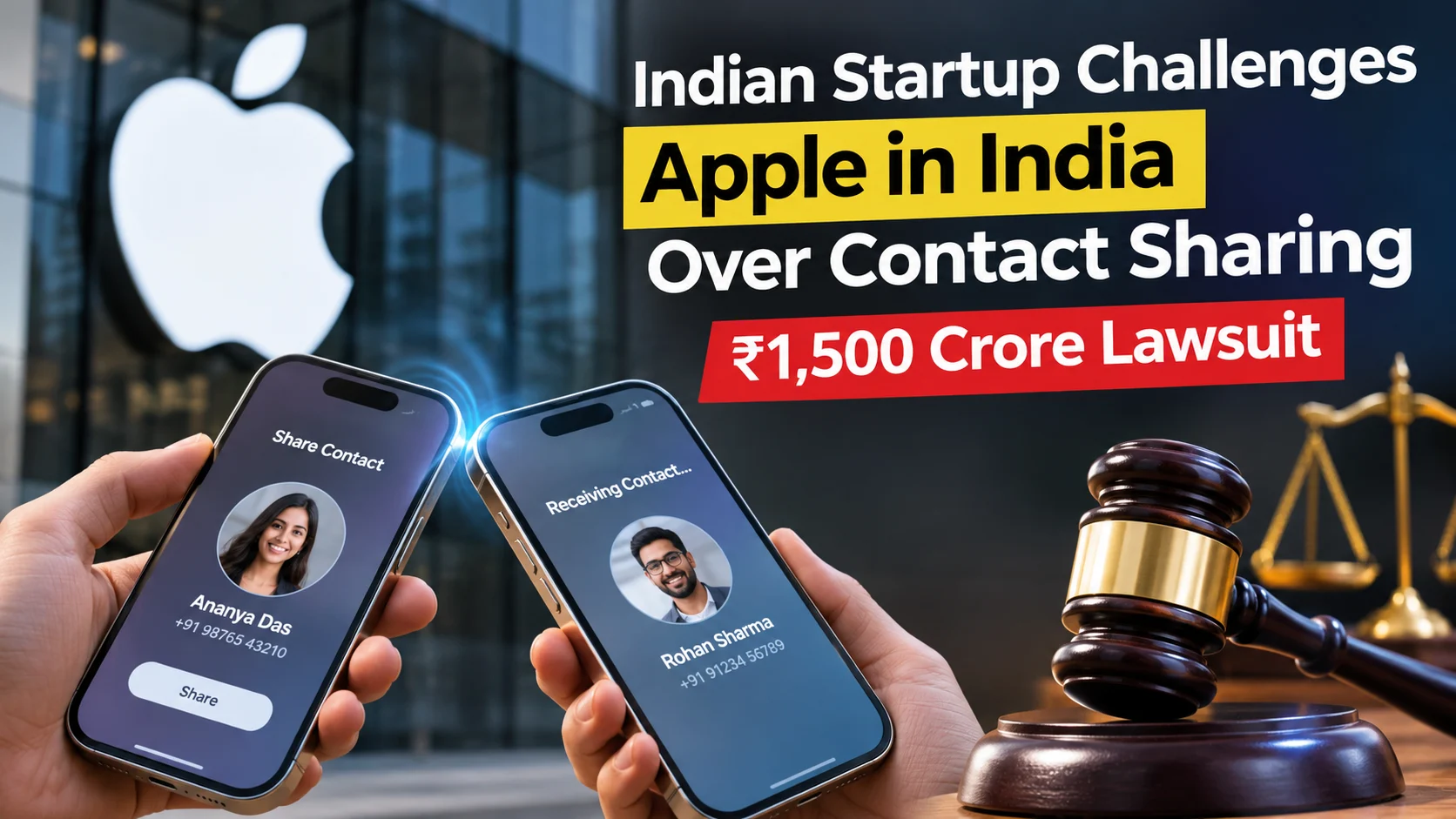
Apple is facing a patent infringement lawsuit in India over NameDrop, the iPhone feature that lets people exchange contact details by bringing two compatible devices close together. US-based GG Technologies, the company behind the StayTouch contact-sharing app, has approached the Bombay High Court seeking ₹15 billion (₹1,500 crore) in damages and an injunction against Apple. The allegations have not been proven in court, and the case had not yet been listed for a hearing in the latest reports available on November 22, 2026.
What Is the Apple NameDrop Lawsuit About?
GG Technologies alleges that Apple’s NameDrop feature infringes an Indian patent covering technology for exchanging contact information between nearby devices without manual pairing. The company is seeking ₹15 billion in damages and has asked the court for restrictions affecting iPhones and Apple Watches supplied with NameDrop.
The case was filed in October 2026, according to reporting based on court documents. GG Technologies said it began pre-institution mediation in April 2026, but the process failed in September. Its filing before the Bombay High Court reportedly runs to 781 pages.
It is important to understand the legal position: these are claims made by GG Technologies. The filing of a lawsuit, and the grant of a patent, do not by themselves establish that Apple has infringed that patent. The court must consider the patent claims and the evidence before reaching a decision.
What Are NameDrop and StayTouch?
NameDrop is part of Apple’s AirDrop feature set. Apple introduced it with iOS 17 in 2023, with support for compatible Apple Watch models added through watchOS 10.1 later that year. It allows people to share contact details by bringing the top of their iPhones, or a compatible iPhone and Apple Watch, close together.
StayTouch, developed by GG Technologies, is a digital alternative to exchanging business cards. The startup launched the product in 2019 and says its technology enables nearby devices to exchange contact details without the user manually pairing them. StayTouch is available for iOS and Android, according to the company’s coverage in TechCrunch.
The dispute is not simply about two products having a similar purpose. GG Technologies argues that the underlying process used by NameDrop overlaps with the technology described in its Indian patent. Apple has not publicly set out a response to the Indian allegations in the reports cited below.
What Technology Does GG Technologies Say Apple Copied?
According to reporting by Inc42 on the startup’s court filing, GG Technologies points to a sequence involving nearby-device detection, device identification, user consent and the selective sharing of contact information. It also alleges that StayTouch uses a central server to store contact profiles and synchronise changes, and argues that Apple’s iCloud infrastructure performs a comparable role.
GG Technologies says it developed StayTouch in 2019, applied for protection for the technology in the United States that year, and filed its Indian patent application in 2021. The Indian patent was granted in July 2024.
There is an important limitation to the technical claims. Inc42 reported that two expert assessments commissioned by GG Technologies identified similarities, but the experts did not have access to Apple’s source code and relied on publicly available information. Those assessments are not a court finding. Apple could dispute whether NameDrop uses the same technical steps or architecture.
What Is GG Technologies Asking the Court to Do?
GG Technologies is seeking ₹15 billion in damages. It has also asked for an injunction aimed at restricting NameDrop’s use in India and the sale or import of Apple devices supplied with the feature. Reporting on the plaint says the startup has asked Apple to disable NameDrop in India through a software update, to the extent technically feasible.
This should not be described as an existing ban on iPhones or Apple Watches. The requested relief is what the plaintiff wants the court to order; it is not an order that has already been granted. The latest reports say the Bombay High Court had not yet listed the case for a hearing.
Will the Lawsuit Affect iPhone Users in India?
There is no reported court order in this case requiring Apple to disable NameDrop or stop selling iPhones in India. Based on the latest available reporting, compatible devices can continue to use the feature while the legal process develops. Users do not need to change their settings because a lawsuit has been filed.
NameDrop also does not automatically send a person’s entire contact list to someone nearby. Apple’s instructions say users see a prompt on both devices and can choose whether to share their contact card or receive the other person’s details. Users can select which contact fields to share, choose to receive information only, or cancel by moving the devices apart or locking the iPhone before the transfer completes.
How to Turn Off NameDrop on an iPhone
People who do not want to use NameDrop can disable the proximity-based sharing option. On an iPhone, open Settings and follow these steps:
- Tap General.
- Choose AirDrop.
- Turn off Bring Devices Together.
Apple notes that this setting turns off NameDrop and other Bring Devices Together features. You can still manage the information on your Contact Card and decide what details you share through other methods.
For step-by-step instructions, see Apple’s official NameDrop user guide.
What Is Happening in the United States?
The dispute also has a US track. GG Technologies filed a related patent lawsuit against Apple in the United States in April 2026. In August, the US International Trade Commission opened an investigation following a complaint by the startup. GG Technologies is seeking remedies that could restrict imports and sales of devices found to infringe its US patent.
These US proceedings are separate from the case before the Bombay High Court. An investigation being opened is not the same as a finding of infringement, and it does not automatically determine the outcome of the Indian lawsuit.
Why This Case Matters for India’s Technology Industry
The dispute raises a wider question for technology companies: how should patent rights be assessed when a large platform builds a feature into its operating system and a smaller company says it developed a similar method first? For startups, the case highlights the value of documenting product development, filing patent applications in relevant markets and keeping evidence of how a technology works.
For consumers, the immediate issue is practical rather than legal: whether a court eventually orders a change to NameDrop, and whether that affects the way compatible Apple devices are sold or updated in India. Until the court issues an order, the startup’s requests should not be treated as a change to the current availability of the feature.
What Happens Next?
The next significant development to watch is the listing of the Indian case and any directions the Bombay High Court may issue. The court will need to consider GG Technologies’ patent claims and evidence, as well as Apple’s response. The US investigation may provide a separate legal path, but neither proceeding should be treated as a final ruling until the relevant authorities issue a decision.
TechCrunch first reported the Indian lawsuit after reviewing court documents, while Inc42 provided further detail about the startup’s technical allegations and the limitations of the expert assessments. Read the original reports: TechCrunch’s report on the Apple NameDrop lawsuit and Inc42’s analysis of the patent dispute.
AxomLive will update this report when the Bombay High Court lists the matter or when there is a substantive development in the case.